Where Cathy adores a minuet,
The Ballet Russes, and crepe suzette,
Our Patty loves to rock and roll,
A hot dog makes her lose control –
What a wild duet!
Patty Duke, aka Anna Pearce, died earlier this week at the age of 69. Many of you know of her early struggles in life, her three failed marriages, and her battles with mental illness. What you may not realize (I certainly didn’t) was she lived the last thirty years happily married, her bipolar disorder under control, and her relationships with her sons, actors Sean and MacKenzie Astin, intact despite their admittedly tumultuous upbringing.
That’s a lot more than a lot of celebrities with even some parallels to her life can claim.
I loved her show as a child. I thought Patty and Cathy were incredibly fun, her parents were wonderful (near-perfect, but of course they were fictional) and her brother, while pesky, was tolerable. And of course there was that goofy, good-natured boyfriend.
A friend of mine in college told me he thought all families, except his, were like Patty and Cathy Lane’s. How many of us believed that same myth? Certainly Patty Duke’s family life wasn’t anything like what she portrayed on TV. Oh well.
In the last 20 years she valiantly worked to lower the stigma associated with bipolar disorder, and I believe she was successful. Thank you, Anna.
My sympathies to her husband, children, grandchildren and many friends as they grieve their loss.
Tomorrow is my sister’s birthday. She’s a year younger than me, and we’re completely different. We look different, have different interests and in many ways, a different outlook on life.
For reasons of her own, she’s been out of contact with the family for many years now. We miss her. She will always be my sister and I love her.
I don’t know if she reads this blog or even knows it exists. If you do (well, even if you don’t), Happy Birthday Beth! I hope your day and your year are filled with unexpected blessings.
Back in the day, rather, the days before e-mail, texting, or messaging of any sort, I used to send a lot of letters, and get a lot of letters in return. If I’d known how rare they’d become I’d have kept more of them. The ones I have are a chance assortment of cards I liked, notes that got “filed” in an odd place, only to show up years later, or a few, very few, that really meant something to me.
Dave & Laurie’s daughter is a sophomore in college now
Friends used to send pictures, too, of their weddings, babies, families as they grew. Some still do. My friend Melanie sends wonderful cards every year of her, her husband Tim and their children, Alec & Amelie. This despite the fact she posts regularly on Facebook. I’ve kept them all.
In fact, while I may have lost the letters, I’ve kept most of the pictures. It doesn’t matter how many you post, because those are fluid and no one saves them, really. It’s the hard copies that end up in photo albums you’ll treasure for the rest of your life.
Or not. There are some pictures that mean nothing to me now. I’m not even sure who everyone is, let alone what they may doing today, and I’m not particularly interested in finding out. Oh well.
But the letters.
Most of those I have were written right after college, and they’re filled with hope and optimism, fear and anticipation, not the weariness that comes after illness and divorce, the death of a child or the loss of a spouse. Parents are gone now or needing care, jobs can be fleeting.
Of course there are grandchildren and a million other successes, unique to the individual, that we celebrate, but so rarely with letters anymore. I love that I have easy access to my long-time friends through the Internet, but I regret that all of that communication is so easily disposed of when we empty the trash in our e-mail. I don’t even think to save it, let alone the pictures that show up on Facebook or Instagram.
I bemoan the fact that so many schools are no longer teaching cursive writing. It seems foolish to lose that part of our culture, to tell our children it doesn’t matter.
I’ve moved a lot in my life; I’ve lived in at least five different states, and I expect I’ll move again at some point. I’m always fascinated by the places by friends choose to live, and wonder what drew them there. What have their lives become, day to day? Despite the easy access to quick messages today, or perhaps because of the very nature of those messages, they were more likely to tell me that sort of detail in letters.
And while I say more when I type and possibly say it more eloquently, there’s something to be said for a handwritten note or letter. I bemoan the fact that so many schools are no longer teaching cursive writing. It seems foolish to lose that part of our culture, to tell our children it doesn’t matter.
Handwriting works magic
with a special part of your brain. You remember things you write down far better than you remember things you type. Your handwritten thoughts tend to be different then your typewritten ideas.
I write like a left-handed person, but with my right hand, so I always end up with ink on the side of my hand if I write for any length of time. That used to bother me, now it’s a point of pride.
Obviously, I can’t dispute the value of typing. But must we completely give up handwritten letters, or even simple notes with birthday cards?
You used to express who you were in part through the stationary and cards you chose. If you wrote a lot of letters, you got the stationary that had a front sheet, matching sheets (because your letters were too long for one page) and of course, matching lined envelopes.
Perhaps it’s my love of writing that makes me sentimental. If you want to give me the perfect gift for Christmas, a nice pen will do, and maybe…a letter.
Fresh out of high school, I was driving my shiny new Corolla on the freeway when a car passed by with a seemingly friendly honk.
Unsure as to its exact intent, I glanced over at the driver, who saluted me, while his passenger, likely his wife, leaned over and waved. I’d never seen them before, and as far as I know, haven’t met them since.
That split-second encounter sustained me for days. I was struggling with a not-yet diagnosed mental disorder and falling into deep despair on a routine basis. My parents, now in the middle of their divorce and focused on their own lives, were distant and angry when I turned to them for encouragement. I had little in common with my siblings, and we weren’t much of a support system for each other.
So for strangers to reach out to me in that small way, for whatever unknown reason, meant a lot. What made it even more meaningful was the weary look on both faces of this couple, who had two curly-haired children asleep in car seats and luggage piled high in the back of their small out-of-state station wagon. As young as I was, I knew enough to feel for them, and to appreciate a friendly gesture made despite their own obvious fatigue.
I said a quick prayer for those people who would always be strangers to me, and over the years since, when they’ve come to mind, I’ve done the same again.
I trust their small yet meaningful act of kindness has come back to them at times they needed it most. Who knows what road life has taken them on; mine certainly went nowhere near the path I anticipated.
A gracious word, a flagging but compassionate nod, an unexpected and sincere grin. Never doubt it: little things mean a lot, and your smile can light a dark path.
I learned a lesson that shaped my life in what was perhaps a tangential conversation to a day’s English lesson, and gave meaning to a well-intended, yet immensely distressing, event a year before.
I was a freshman in high school, and oh-so-fortunate to have a teacher named Paul Meredith. He taught not only the accelerated English course I was in, but the course for those who struggled so much they didn’t even qualify for the most basic of English classes. The kids on the outside, the ones we didn’t see.
Of course we called him Mr. Meredith, and one day, Mr. Meredith told us, “it’s not what happens in your life that determines who you are, but how you handle those events.” Or words to that effect. A new thought for me that day, but one that’s echoed throughout my life.
There was another Paul who entered my life a year before, in eighth grade. This Paul was one of those we didn’t see in high school, but in junior high, because our school was so small, he was visible.
Paul had been going to a different school up to then, called Mark Twain, for boys with behavioral problems. Much to my shame now, we tended to look down on them. Paul apparently had progressed enough they thought he could handle coming back to our “regular” school.
I guess he had a crush on me. He stood out from the other boys in my class because he always called me by name and was incredibly polite. I bet someone had worked with him on that.
One day I was wearing an elastic-waist skirt, peasant-style with a matching blouse, and another boy yanked it down. While my friends scrambled to pull it back up, Paul hit the boy in my defense, more than once. In fact, I think there was quite a scuffle. As a result, he was sent back to Mark Twain.
I had a hard time with that. I kept trying to explain what had happened, that he was only defending me. My parents & teachers told me his intention wasn’t what got him in trouble. It was how he handled it. Much later, I finally understood
I’ve cried more than once remembering him, and what he did on my behalf that cost him. It wasn’t about me, yet, it was. I hope someone told him, “Paul, yeah, you messed up, but hey, she stood up for you. You made the right impression.”
What’s more, for years I’ve wanted to tell Paul that whether or not I showed it, whether or not I even realized it at the time, I deeply appreciated his calling me by name.
No doubt his anger was the consequence of something that wasn’t his fault, and ultimately, it wouldn’t be what happened to him, it would be how he handled it that would determine the man he would become. Anger is tough to change, but he was young, and he was trying.
To both the man and the boy named Paul, I remember you.
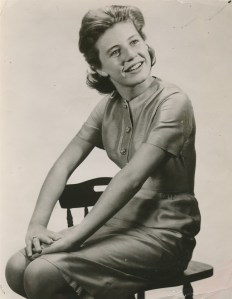 I loved her show as a child. I thought Patty and Cathy were incredibly fun, her parents were wonderful (near-perfect, but of course they were fictional) and her brother, while pesky, was tolerable. And of course there was that goofy, good-natured boyfriend.


 My World With Words
You must be logged in to post a comment.