



Paco came into my life in a roundabout way. I first learned about him when I renewed my apartment lease and asked about the costs associated with getting a cat.
“Rent’s an additional twenty-five dollars a month,” Carrie, the leasing manager, told me, “and there’s a five-hundred-dollar non-refundable deposit.”
I felt a tightness in my throat and tears welled up in my eyes. I’d been ready to adopt a cat for some time, particularly after my break-up with a long-time boyfriend a month before. “I’ll have to wait. I just don’t have that kind of money.”
“If you want a cat, I’m trying to find a home for one.” Carrie pushed her chair away from the desk and placed my file in a drawer.
“I really can’t afford it.”
She brushed the air with her hand and started telling me about a sweet little kitty the maintenance man, Jim, had rescued. Jim had been concerned about this kitten’s survival for some time, as he appeared to be homeless. During a classic Nashville downpour, Jim watched the kitty tread carefully along the edge of the fountain that sat in front of the apartment management office. In a heartbeat, the cat disappeared. He’d fallen straight into the fountain.
That tumble did it. Jim rescued this poor kitty, who was futilely trying to claw his way out of the water, and brought him to Carrie. She took him in. Since then she’d been trying to find the kitty a permanent home.
It took me a moment and some more protests to realize she had dismissed my financial concerns when she brushed the air. If I took this cat off her hands, there would be no additional charges. Eagerly I agreed to adopt the kitty, and we arranged a date and time to pick him up. I needed to wait until payday to get a litter box, cat food and a toy or two.
I took on that cat sight unseen and accepted Carrie’s word when she told me how adorable and friendly this little guy could be once he got to know you. A potentially disastrous mistake.
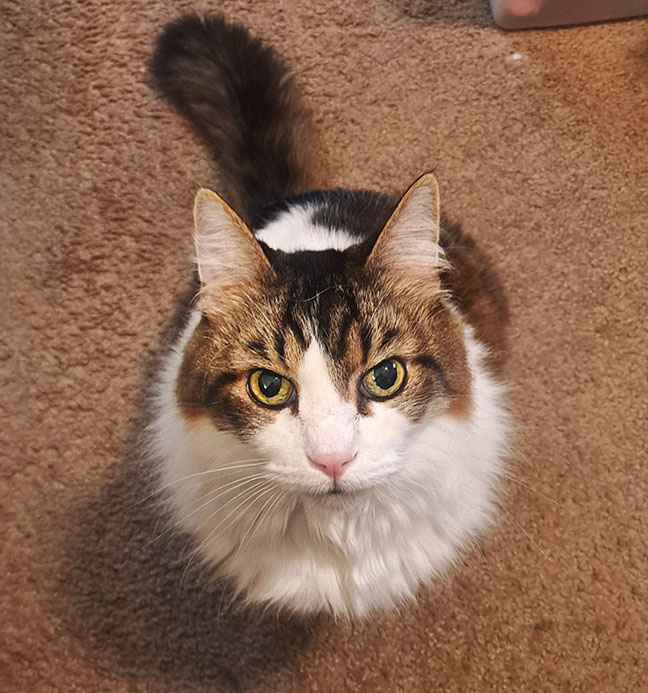
Paco, at an estimated seven months, had feet and ears too big for his scrawny little body, a narrow face and a long nose. Not the least bit adorable. What’s more, he bit. My ankles, my legs, my arms and my hands all faced attack at any time, night or day. Not the least bit friendly.
“Mom, I have to learn how to love a homely, angry cat.”
“I’m sure he’s better than that.”
Mom kept reassuring me that Paco must be cuter and sweeter than I thought, until she visited us.
“Once he puts on a little weight it should be better.” She held Paco until he bit her.
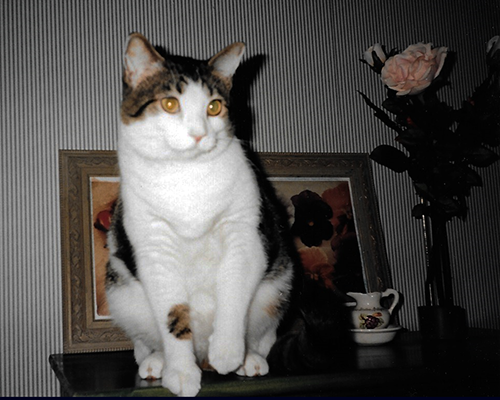
Gaining weight wasn’t a problem, however, it took some time to train Paco not to bite, and he never completely broke the habit. Years later, when he spent time at the Cat Clinic to treat some illness born of old age, it broke my heart when clinic staff placed a sign on his cage saying, “Stay Away! He BITES!” Of course they fed and cared for him, but he lost out on what little affection the staff might have shown him during his lock up.
Paco and I needed each other. Shortly after he came into my life, I began to deal with the effects of childhood sexual abuse. For days on end I fought an oppressive depression, one that sat on my chest like a weight. While not exactly suicidal, I struggled with a desire to escape this overwhelming pain. However, when I looked into Paco’s face, I couldn’t bear the thought of leaving him. If I died, I knew no one in my family had room for another cat. He likely would go to Animal Control, and that would be the end of him. That couldn’t—and wouldn’t—happen. Not on my watch.
He sat a few inches from my side when we watched TV together. I would knit, and mercifully he responded when I stopped him from playing with my yarn. “Rule Number One – no playing with Mama’s knitting,” I intoned as I placed my hand gently over his front paws. In short order we had that rule down.
Coming home became the best time of day for me, and likely for him as well. As I sat in traffic I thought, twenty minutes to Paco. Ten minutes to Paco. Three minutes until I pulled into my parking space. I’d hurry to our apartment and open the door. He’d dash outside, but after the first time or two that didn’t worry me. He would run up the outside stairs and trap himself in a corner, purring away as I reached down to pick him up and carry him back home.
One holiday weekend I visited my brother two thousand miles away and brought Paco to my mom’s for caregiving. When I got back and went to pick him up, he dashed toward me.
“He waited for you all weekend,” my mom said. “At 5:00 Friday he was at the door waiting for you, and he sat there until I moved him at 10:30.
“Oh, poor kitty,” I murmured to him.
“Then he sat in the living room corner the whole time. He only moved to use the litter box or drink some water.”
From kittenhood on, Paco never stopped loving his favorite toys, some golf-ball sized foam balls. I’d toss them down the hall and gleefully he would chase after them, then I’d switch places and throw the balls the opposite way.
He would signal he wanted to play with the foam balls by rolling one into the den from the hallway, so it landed right in front me. If I leaned over to check on him in the doorway, he’d duck as if to make certain I wouldn’t realize the ball came from him. I got the hint, and the ball-tossing would begin. If I failed to respond in a timely manner, a second ball would roll before me, knocking the first one as if playing croquet.
In the last months of Paco’s sixteen years I more fully treasured him. Accused of a crime I did not commit, dealing with an ongoing investigation and facing a criminal justice system I did not trust, often my only solace came from Paco. My mom had moved three states away and I had no family nearby. I couldn’t discern between my friends and my enemies. Yet through it all, I had the comfort of his precious love. On days when my legal situation appeared particularly bad, he sensed it and would burrow onto my lap, weighing me down so I couldn’t get out of the chair until he allowed it.
In the end, kidney failure separated us for the final time. I whispered to him in his last moments, “you saved me, Paco Bear.” He growled as was his wont, but it came out a weak growl. I knew the time had come to say good-bye and let go.
But do you ever let go?
Image Credit: Header (Loving Cat) © pingpao–stock.adobe.com






 My World With Words
You must be logged in to post a comment.