

Okay, never say never. But it seems unlikely these films could be made today, for the reasons I’ve listed.
I’ve added one film that was limited by the restrictions of yesteryear (and perhaps some bad choices by the producers, directors, screenwriters and/or actors). Still, the story is worth telling, and if the right people took it on…
All of these films have been reviewed on my other blog, Classic for a Reason. Click on the title to see the individual reviews, and if you get the chance, check out these movies!
The More the Merrier

A single woman rents out the spare room in her apartment to two strange men? It was a controversial idea at the time, but today it likely would be nixed because of the danger factor, not the sexual one.
The Bachelor and the Bobby-Soxer

A man suspected of seducing an underage girl is sentenced to date her? While there would be outrage at the concept now, Cary Grant and Shirley Temple (with the able assistance of Myrna Loy) make it plausibleand–really funny.
The Thin Man series

Since we all know drunks don’t get more charming and capable with every martini, Nick and Nora’s sophisticated use of liquor would be suspect. Besides, some classics just should be left alone.
Dark Victory

You have to tell the patient she’s dying. You just do.
And the film the right director should take on…
In This Our Life

This is an incredible story based on the Pulitzer Prize-winning novel of the same name, and the movie is good, but it should be great. There is so much going on it actually would make a good multi-part series (you know, six episodes on HBO, that sort of thing). Bette Davis and Olivia de Havilland alone make it worth watching, and it was John Huston’s second film (after The Maltese Falcon), but it just doesn’t quite reach its full potential. And, I’d suggest they change the names of the lead characters. Stanley and Roy are simply not great names for women.
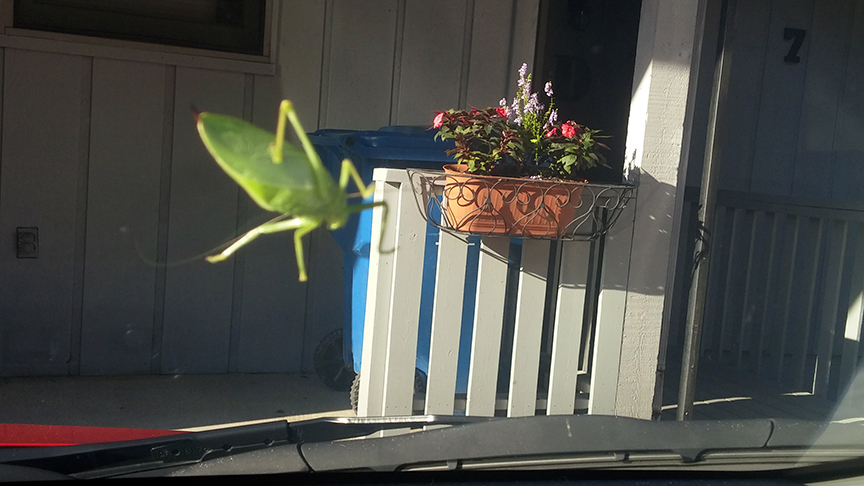
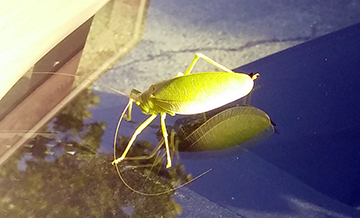 Okay, beautiful is relative. I do not like bugs. No matter how remarkable they may be, down to the veins in their leaf-like wings. Or how tenacious.

 I run in, race out, get behind the wheel. Sitting there, I am so overwhelmed, I can barely move the key to the ignition.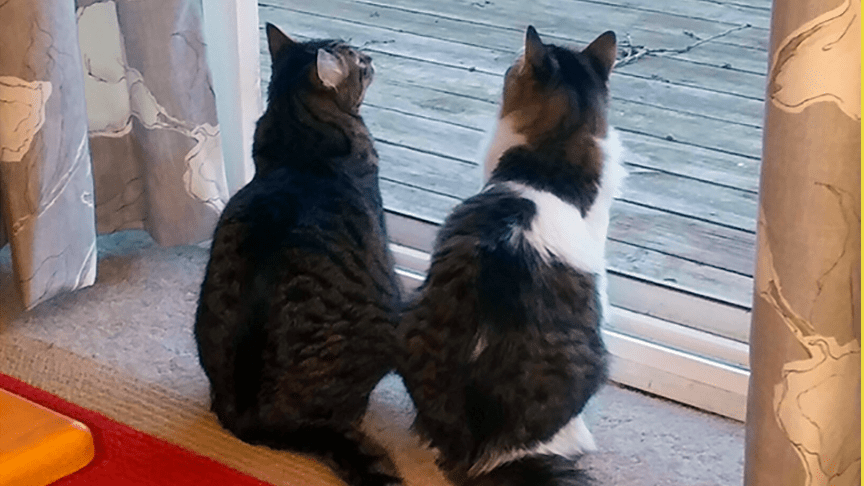
 I house-sat last year, and hauled the cats over to this pretty place on the lake, with woods and the brush all around. No way in heaven or earth I was going to let them run free. Not only would they likely get lost, whoever did find them (probably a coyote) would discover them covered in ticks and fleas and whatever other grunge lies out there.
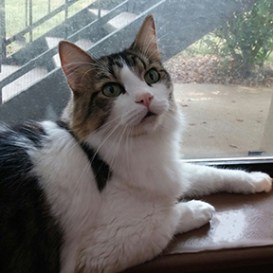 Do they dream of the big hunt? Right now there’s the occasional bug to stalk, but I usually reach my limit watching that game after a time and kill the thing myself. They tend to let it go otherwise. Unless it’s a flying bug. Walter is adept at catching bugs in flight, and has no compunction eating his capture.
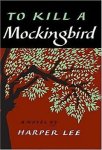 Race continues to divide this nation, and the quiet example of Atticus Finch in this Pulitzer-Prize winning novel is worth remembering. I know, the prequel creates a different picture of the man, but there was a reason Harper Lee told us she’d “said all she had to say” with To Kill a Mockingbird. In addition to Atticus, it’s uplifting to remember Boo Radley, and the straightforward point-of-view of young Scout paints an honest and at times innocent picture of the world. Don’t miss the 1962 film, either.
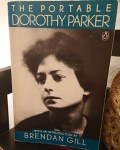 The perfect book if you’re too busy for a novel. Short stories, articles and poetry abound in this volume. Parker took a sardonic look at just about every aspect of life, and it’s intriguing to note the change in her writing (particularly the short stories) over the years. Her tales are as timeless as human nature, however, no matter what changes may have taken place in her style of writing, and capture the subtleties of such things as young love and racism.
 Ah, romance, true love and all that. The fairy tale comes crashing down, and you’re left wondering if the bliss of it all can be recaptured. Was Rebecca the better woman, the better lover, the better wife? We agonize with our unnamed heroine as she struggles to gain her foothold in a trepidatious situation and overcome her insecurities as the second wife. Who was Rebecca, and why does she still haunt all whom she left behind? A darn good movie, too (the 1940 Hitchcock version, starring Joan Fontaine and Laurence Olivier).
 I hesitated to call this one a classic since it’s not even 30 years old, but it’s on high school reading lists, so there you go. Written with Irving’s customary nod to the outlandish, but a bit of a departure from his usual style, it captures the intense feelings of fate, faith, friendship and the follies of youth and creates a clear visual of both main characters as they grow up and enter the world. Owen Meany believes in destiny, and lives his life with the knowledge he is “God’s instrument” and must fulfill a pre-ordained plan.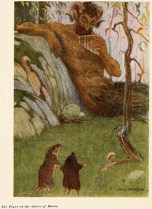
 These are well-defined characters, and their stories have a rhythm that is almost poetic (consider the title of one tale, “The Piper at the Gates of Dawn”). There’s a reason I still have my childhood copy.
 My World With Words
You must be logged in to post a comment.