
Garbage In, Garbage Out

I got some distressing news from my Internet provider today. Apparently, they don’t service WordPress.com. That means that connecting to my blog is sporadic and frustrating. I’m connected now, obviously, but in the future I may need to take my laptop to work to be able to post anything on a regular basis.

In case you’re wondering, it’s AT&T Internet Air. I called them and spent a half hour with their tech services, and in the end the nice man who’d been helping me said, sorry. Nothing more we can do.

The night before I spent two hours with one of WordPress’s Happiness Engineers, who was also very nice, but ultimately we realized the problem wasn’t with WordPress. So I’m frustrated. I don’t know how often I’ll be able to post since connecting is so difficult. I’ll keep trying, of course.

Technology is not perfect. We’ve come to depend on it, but things like this happen. At work, one of our customers has a very flawed system for reporting claims, which is what my department handles. A co-worker says they just need AI, but the bottom line is, garbage in, garbage out. They used to say that a lot, remember? Now it seems you don’t hear it as much, but it remains a fundamental truth for computer science.
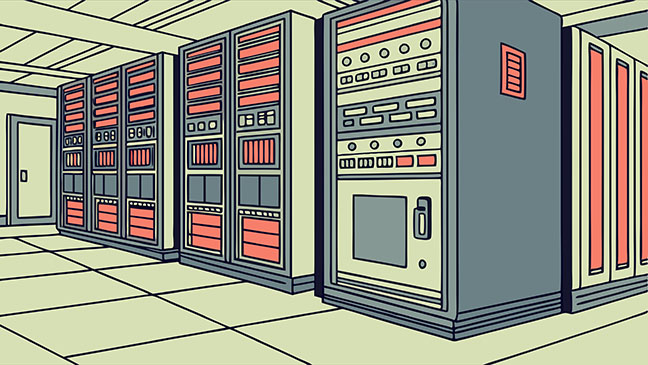
It looked sort of like this.

My dad worked with computers for years, starting in 1959. We used to go down to his offices and see the giant green computers all housed in one room. I was in awe of them. These machines would spit out all kinds of code that my dad and his colleagues refined as much as possible. Recently he told me that at one point, a large number of employees were working on a project and they split up into teams that each worked an eight-hour shift, so someone was working on the project 24 hours a day.

His shift was 4 a.m. to noon. One day my mom said she didn’t think she could handle that schedule any more (it left her dealing with three small children alone most of the time), and he told her, it would end on Thursday. She was dubious. How did he know? Because that was the day they were going to ship the program out to the customer, he said. Any problems that came up after that would be dealt with as they arose.

It seems that’s similar to the way problems are dealt with now. How many updates do we get to our operating systems? No one, not even Microsoft, can guarantee that their programs are perfect when they first release them.

So I’m holding out hope that my problem with my Internet is being addressed. For any number of reasons it isn’t practical for me to change providers. If my posts are more sporadic than ever, you’ll know why. If they’re more frequent, it’ll be because I connected and took advantage of the situation.

Image Credits: Frustrated Man © Brian Jackson–stock.adobe.com; Computer Room © Londita–stock.adobe.com

No Computer? I Remember It Well.

Daily writing prompt
Your life without a computer: what does it look like?

Well, like so many of us, I’ve become dependent on my computer and phone (or mobile device, as they accurately say in some countries). But I lived the first half of my life without a computer, so I know exactly what my life would look like. I’m including cell phones in this post. They’re as much a part of my “computer life” as my laptop is.

Okay, without a phone, you didn’t leave home without change for a phone call. Or money for a cab, if you were on a date and were concerned he might not be the gentleman he appeared to be. For a long time, that call was just a dime. Then it became a quarter–then I’m not sure where it went. It got expensive.

Before there were cell phones, you may have had voice mail, or you may have relied on an answering machine. The latter was a great way to screen calls since it had the caller’s name on it, unless they blocked the number. Can you even block number on a cell phone? I’ve never really looked into it. The other nice thing about answering machines is you could hear your message and pick up the phone if it was someone you wanted to talk to.

But before voice mail or answering machines, you ran to the phone if it rang, because there was no way of knowing who it might be and It Might Be Important. I remember in high school one of my English teachers shocked our class by saying he didn’t always answer his phone when it rang. What if someone needed to reach you? we asked. I don’t remember his answer, or if he even gave one.

Of course there was no texting then, either, so you had to make a call to communicate with someone outside of your home.

My first job out of high school was at a bank. These days everything is done online, but back then, you got paid with a paper check that you had to deposit at a bank. Needless to say, pay days were busy. People would wait an hour in line, and we had fifteen tellers. There were no ATMs, either. The first ones were introduced while I was on that job, and they were game changers. But I don’t remember how you got the cash back, since there was no such thing as a debit card.

If you were sticking to a budget, you might write out checks to pay your bills once a month, then mail them the next day. You needed a lot more stamps back then. If you misplaced a bill, there was no email reminder to pay it and you might get behind in your payments.

Blogs? I guess the closest substitutes for what I’m doing here now would be journals or letters, and that meant hand writing everything. Which brings me to my next point. When I was in high school, I was told not to take typing, because if I knew how to type and my future boss knew this, I’d always be a secretary and could never move up. Through circumstances I won’t describe here, I did take a typing class, but came into the class late in the semester and never caught up. To this day I can’t type particularly well. Thank goodness for spell check.

So, like I said, I know what my life would look like. And I don’t like it.

Image Credits: Typewriter © olegkruglyak; Coins © LONDON2010; Rotary Phone © SRRiadi; Check © HaywireMedia All, stock.adobe.com