
the strength of good words

the kids at Coney Island

Fresh out of college and packed for my dream job in Europe, I took a drive down to visit my great-aunt Vi.

vi
My great-aunt, Violet Panzram, 1910-1996

I was caught off-guard by her enthusiasm for my continental venture. “I can’t believe I’m related to someone who’s doing something as exciting as this,” she exclaimed.

This from someone whose travels and life experience rivaled that of just about anyone I knew or have know since. I didn’t know what to say, but I felt so…significant.

(The dream job ended up being a nightmare, complete with monster. Oh well. A story for another time.)

A few years after that,

I was restless and bored one evening, and found myself, an established critic of soap operas, watching the Daytime Emmy Awards just to see if Susan Lucci would win Best Daytime Actress (this was a big question each year back in the 90s).

I don’t recall if she did or not – probably not – but I clearly remember that year’s Lifetime Achievement Award went to a man I, along with everyone I grew up with, had spent years mocking: Fred Rogers, of Mr. Rogers Neighborhood fame. I changed my mind about him after hearing his speech that evening. He spoke of his own childhood, and how his grandfather, upon seeing young Fred, would always stop what he was doing to tell his grandson his day was good because he was in it.

Those are good words. They reminded me of my great-aunt Vi, who had since passed away.

Even as I write this, there’s an internal rebuke:

I’ve dished out passive-aggressive criticism to two people already in this short piece, Susan Lucci and Fred Rogers. I’ve never met either of them, and never will (Fred Rogers passed away in 2003), but each has a long-established reputation of kindness and decency.

Who am I to mock others, no matter how lightly, just because it’s the popular thing to do? Simply reporting the truth is one thing, but the intent or manner with which it’s said is another. Look at how I talked about Ms. Lucci a few paragraphs back. It was true, but it really wasn’t very nice.

the kids at Coney Island
Two people who make my day good

The first words anyone should hear me say about another person should be the best words. Realistically, I’m not going to speak well of everyone in my life all the time, but I want people to know who I am and where my heart is, and I want my heart to be in the right place. That place should be respectful and non-judgmental.

I want people to know me for my good words. I want to be remembered for making other people feel significant. And I want it noted both Susan Lucci and Fred Rogers deserve kudos for far more than just their talent and hard work. I’m a fan of them both.  

truth to tell

And then...and then..
“And then…and then…”

It’s at times entertaining to watch a pre-schooler try to lie their way out of a sticky situation. So endearing, in fact, parents may pretend to believe everything the little tall-tale-teller is saying, just to hear them say it. They’re so earnest and sincere.

Not my second grade teacher, though. Mrs. Smith didn’t take falsehoods from anybody, in particular her son, Tim. One day she told our class Tim had only lied to her once, back when he was three years old. She caught him, and he was so ashamed he never did it again.

Not one kid in our class bought that story. She stuck to her guns. Tim was as honest as the day was long.

A few weeks later this poor guy, now 19, showed up at our class to drop off car keys for his mom. He innocently walked into a room full of skeptical, disapproving seven-year-olds, having no idea of the tale we’d heard. In short order, his face was as red as his scruffy, shoulder-length hair. He didn’t look like a saint to us and we had no problem saying as much.

Maybe we weren’t being fair and he actually was that good. I can’t imagine any child NEVER lying to their parents, but I’m not sure what it said about us kids that we were so jaded about telling — and hearing — the truth.

I was visiting a friend last summer and as I approached the front door, a child about the age of her youngest daughter came running up to me. With hair cropped short, jeans and a team-logo sweatshirt, I assumed it was a little boy, probably a neighborhood friend. It wasn’t. It was her wild child five-year-old girl, who told me she’d cut off her shoulder-length hair the week before. All by herself.

blue scissors II smI laughingly asked Pam about it, and she signaled me to come inside.
“That girl’s hair was cut short and straight across the back,” she said in a low, firm voice. “And there wasn’t one single scraggly piece I had to trim. No way she did it herself.”

Right at that moment one of Pam’s older daughters walked by. “We told you what happened!” this one said defensively.

“I know what you said,” she replied mildly, then turned to me and continued in the same low, yet clearly distinguishable to those eavesdropping, voice. “They’re not telling me the truth and it’s obvious what happened, but since no one was hurt, I just punished all of them for leaving the scissors out.” Older daughter walked away.

Pam looked at me and sighed. “I have no idea what happened and I can’t get them to budge on their story.”

No illusions on her part. I don’t think her girls are particularly dishonest or deceptive, in fact, I think they’re fairly transparent. Well, two are teenagers now, so let me revise that: for the most part I think they are, at the heart, trustworthy girls. One of whom probably cuts hair.

When I was young, I was always afraid what would happen to me if I was caught being wrong. That was how I saw it, by the way, being wrong, not doing something wrong. I became a pretty decent liar. I was clever, with a good imagination and even better memory. Fortunately, I got tired of it, physically, emotionally tired, and I stopped well before adulthood.

My parents were not abusive, so I can’t say what it was that caused that fear, probably a more subtle message they weren’t aware of and didn’t intend to send to their highly sensitive child. What could they have done differently? I don’t know.

I’ve said it before: parents, you have an impossible job, but you do it. Hang in there. Believe in your children. Believe in their overall character, not their occasional deeds. Know that lying is something any child is going to do, if not this day, the next, for his or her own reason. Deal with it, of course, but save up a few stories to laugh at when they have kids of their own.

my best gifts received, part one

In high school, my friend Sue gave me an ornament for Christmas. I remember being a bit disappointed. It wasn’t much of a gift in my 15-year-old estimation.

angel ornamentSue assured me I’d value it more each year. What she didn’t know was her friendship had far greater value.

At a time when I was awkward and insecure, she made me feel important. The first time I met her was as the new kid in sixth grade. I huddled alone in the corner of the playground, the only girl wearing a dress, waiting for class to start.

Shaking, my back against the brick wall, hands clasped tightly together, I was wishing I’d worn jeans as my mom suggested. All these kids had gone to school together since kindergarten, I was sure of it. I’d never fit in.

Sue with her pigtails & bows and another girl, Nada, approached me.

“Are you new?” they asked in unison. We all giggled.

“Yes!” I said, incredibly happy someone had noticed me.

Turned out we were in the same class, with the same scary teacher. They gave me the scoop. She was fat (apparently important information for sixth-graders) and this was her first teaching job.

I don’t know if I was the friend to her she never stopped being to me.

The next summer Sue’s mom was killed in a plane accident. Her father remarried soon after, and certainly the adjustment must have been hard for her. I don’t know if I was the friend to her she never stopped being to me.

A seventh-grade diary entry early in the school year noted she seemed okay. At least I wondered how she was doing. I hope I asked her about it, gave her a chance to talk. I don’t remember.

In high school, my mental health problems arose. As I started to lose confidence, gain weight and sink into a series of deep depressions, she did her best to make me feel better. “You look real nice today,” she’d tell me on days when my dirty hair was held back with a scarf or my outfit played up the extra pounds. I saw through it and appreciated her thoughtfulness. It meant I had a friend.

Every Christmas I think of her and cry a little, missing our friendship and how much it meant to me.

The last time I saw her was about a year after we graduated. I was walking around a lake near my home and she came from the opposite direction, with a boyfriend, I think.

She was genuinely happy to see me. We had an enthusiastic and chatty catch-up conversation, then moved on in our separate walks. I haven’t seen her since.

I’ve tried to look her up, with no success. Every Christmas I see that ornament, think of her and cry a little, missing our friendship and the opportunity to tell her how much it meant to me.

Still means to me.


Photo Credit: (background) © Diana Rich; (ornament) © Stuart Monk, both — DollarPhotoClub.com

behave (as) yourself! whaaat?

During Christmas break when I was in seventh grade, I added bangs to my one length-fits-all hair style, and for most of my life since then I’ve kept them.

I’ll never be sure how much this plays into it, if at all, but I distinctly remember one boy complimenting me when we returned to class in January.

Beth, Thom & Me Summer 1972
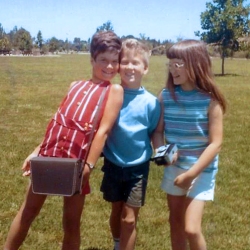
My sister, brother and me (far right) the spring I was in seventh grade

“They look really nice,” he said. “They make your face look less round.”

He was a year older than me, and all through junior high, high school and until the last time I saw him, two years after I graduated, he was particularly nice to me.

I didn’t clue into it until about twenty years later, but I think it was more than just a kind nature.

This very popular, somewhat bad, really good-looking boy quite possibly liked me, the socially awkward girl whose weight fluctuated with the changing tide and insecurities overshadowed everything about her.

It makes you think. I’d realized it already on some level by this time (the age of 36 or 37), but it brought home a valuable truth: no one is who they appear to be on the outside. Why one kid is popular in high school is a bizarre combination of the “right” talents, good looks and circle of friends. He’s not better than the girl with none of that, and if he’s lucky, he knows it.

That continues throughout life. The seemingly perfect couple gets divorced. Most of us knew the Duggars would fall eventually (although perhaps not as far). There’s always the pastor who walks away from his church in shame…that’s just a given in any community. Okay, I’m being facetious with the last one. A bit.

The hooker with the heart of gold. A cliché to make a point.

A close friend of mine made the observation a few years ago that who we are is “not about behavior.” It rang true for me instantly.

In her case, her husband had had a benign brain tumor that affected the entirety of his behavior, including his ability to hold a job or even help with household chores.

Their church, in a gross misuse of its authority, directed him to leave his family until he could figure out how to become “the man of God his family needed him to be.”

He had a brain tumor. He had brain damage. His behavior had nothing to do with who he was.

Now, that’s an extreme example. But there are plenty of people, say, with mental illness, who do things that later shock and humiliate them. Virtually everyone I know, mentally ill or not, has done something so “unlike themselves” they have a hard time confessing it to others.

I wish I’d known that boy liked me, if in fact he did. I wish I’d had the confidence to openly reciprocate his feelings, because I probably would have felt something for him if I’d let myself. I could have learned, early on, one of life’s most valuable lessons: who we are is more than what others see, it’s more than how we behave, and it’s more than we’ll be able to discover in a lifetime.

my best gifts given, part one

In fourth grade our student teacher, Miss Trillman, got married mid-semester.

As a wedding gift from the class, our regular teacher gave us each a 3×5 index card and instructed us to print our favorite recipe on it. It didn’t matter what it was, as long as it was our favorite. As I recall, every one of my fellow classmates gave Miss T the most complex recipe their mom was able to prepare. The cards were carefully printed, and no doubt just as carefully chosen, by their mothers. I took the idea to heart and instead got my mom to calculate the ingredients for my absolute favorite meal of all time, bologna & cheeses.

These aren’t simply bologna & cheese sandwiches, sliced and placed on bread. They are made from polish sausage, cheddar cheese, onions, ketchup and probably one or two other things I don’t remember, all put through the meat grinder and turned into a gooey delight. When Mom suggested B&Cs for dinner, the whole family went shopping with her, just to make sure she didn’t forget any of the ingredients. Each of us had one thing we picked out and brought back to the shopping cart, making the trip a quick one. Heaven forbid Mom should have too much other shopping to do. Our patience was limited.

Once blended, the mixture was then spread on lightly toasted bread (both sides) and broiled until it bubbled a little and the edges and part of the top turn just a little black. It takes a little practice to know just exactly how thick to spread it — too thin and it’s dry, too thick and it’s, well, too thick. But this is the best sandwich ever for kids and adults alike. It takes ordinary ingredients and turns them into something with a sharp taste, better than spaghetti or hamburgers.

If you’re a ten-year-old girl and have just an average appetite, you eat two. If you’re ravenous, you eat three and maybe regret it a little, because it’s too much in the end. The best part is, no matter how hungry the rest of my family was, the recipe made enough for plenty of leftovers, and bologna & cheese holds up well for a couple of days. So two more days of great lunches to look forward to, and you’re still not tired of them.

Miss Trillman, who became Mrs. Peck (distant relative to the actor Gregory Peck), told the class my recipe was her & her husband’s favorite. They all protested because their recipes were fancier and therefore, better, but she told them mine was best because it was perfect everyday food and besides, her husband was a big man with a big appetite and these sandwiches easily filled him up. Another bonus, he liked preparing them, and after a long day with 30 fourth-graders, she didn’t always feel like cooking. We groaned at that comment, but frankly, I’d never doubted my choice would win out over the others.

Image Credit: © Graphic Stock