I finally got in for my long-overdue eye exam on Monday, and was disappointed when I learned the office manager, Corinna*, no longer worked there. “Corinna hasn’t been here since October,” the new manager told me, with pursed lips.
“I’m sorry to hear that,” I said, “but happy to meet you.” The latter statement was a moment of graciousness. I really would have preferred to see Corinna. Several years ago, when I was broke and struggling to put food on my table, she called a local charitable organization and arranged to have them pay for my eye exam, three months of contact lenses and a new pair of glasses.
Since my previous pair was more than ten years old, and my prescription typically results in glasses that cost more than $300, the glasses alone were a huge gift. Throw in the exam and the contact lenses, and I was ecstatic.
I’ve been seeing this eye doctor for at least eight years now, and when I mentioned to him how sorry I was Corinna had left, he, too, grimaced a little, and said, “She was embezzling from me for seven or eight months. I had to fire her.”
He went on to tell me how his attorney relayed four or five more similar stories from other doctors in the area. In my doctor’s case, he chose not to prosecute, since Corinna agreed to pay him back in full, and he didn’t want her children to see her in jail. His wife was ready to throw her behind bars and lose the key, but the long-term relationship, while destroyed, meant something to him.
I learned about this shortly after hearing more details of another similar, but more troublesome, story about a woman who’s dating a friend of mine. I wrote about this once before, and I need to be clear that no charges have yet been filed. However, on the local news, they reported she had embezzled 1.1 million dollars of county funds over ten years.
Of course the question arises, how could this happen? Why didn’t they catch it? The bigger question in my mind is, what was she thinking? She had to understand she’d get caught someday. Her boyfriend’s ex-wife is a good friend of mine, and has told me this woman is in complete denial about what she’s done. She believes she’ll get probation, but not jail time.
This is being investigated by the FBI and IRS as a federal crime, and whether she wants to believe it or not, she is facing years of federal time, which makes me terribly sad, and angry at the same time.
I’ve heard of people who, when facing a financial problem, commit a crime just as a matter of course. That’s how they solve their money woes. For most of us, it’s time to get creative within the bounds of the law and whatever other moral boundaries exist for us.
More than a million dollars over ten years is a lot of money in my world, and I know it was in this woman’s circle as well. She didn’t need that money. She wanted something she wasn’t able to afford, and she sought to hurt others to do it.
I don’t wish prison time on her, but I do wish to see some remorse, some understanding of what she’s done to others in her community.
I don’t know what led her, or Corinna, to steal from their employer. I try to remain empathetic and compassionate. I still like Corinna; she was good to me.
Judge not lest ye be judged. But it’s hard not to judge a little.
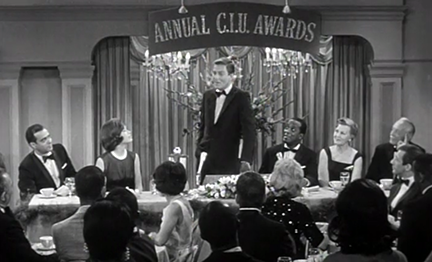
A 1965 episode of The Dick Van Dyke Show shows Rob Petrie (Dick Van Dyke) and his wife Laura (Mary Tyler Moore) accepting an award on behalf of Rob’s boss, Alan Brady (Carl Reiner). The award, given by the fictitious Committee for Interracial Understanding, is for Alan Brady’s contributions to understanding and honesty between the black and white communities.
Mary Tyler Moore, Dick Van Dyke, Joel Fluellen
One sentence in Rob’s acceptance speech gets to me. “It seems to me understanding should be as natural as breathing,” he says. “And you don’t get awards for breathing.”
Understanding in the racial divide is hard work. I’ll be the first to say, I don’t get it, I don’t get what it’s like to be black in America. I’m white, I grew up in an almost exclusively white neighborhood and school district, although as an adult, I entered into much more diverse scenarios.
I have two things going for me in my desire to bridge the gap (well, hopefully more than that, but we’ll start with these two): I was raised in the 60s by parents who believed God made everyone equal, but fully recognized life didn’t treat them that way, and as an adult, I frequently worked with and/or lived in diverse neighborhoods that helped me be at ease with people of numerous ethnic backgrounds.
My high school. Photo c Mike24.
There was a small amount of interracial contact throughout my teenage years. In high school, out of approximately 2,400 students, only one, Tony, was black. Tony moved to my town in his junior year to live with his mom, and a year later, moved back to stay with his dad, where he could go to a school that was significantly more diverse. I was the same age as Tony, and he ended up going to my church, so I got to know him fairly well, in particular because he became close to one of my best friends.
When Tony moved, he didn’t tell too many people he was leaving, so we didn’t get to say good-bye. He did talk to my best friend, Carolee, and she told me he didn’t want a lot of fuss. You see, Tony was incredibly popular, wonderfully talented and in demand socially. He knew we wouldn’t understand why he would want to move to a small town in the middle of nowhere with a K-12 school that had fewer than 400 students. After all, our school ruled.
I didn’t understand. We liked him, and we treated him in the manner you treat someone you like. What I couldn’t see, couldn’t feel and didn’t live was the disconnect between the races, the incredible alone feeling Tony no doubt felt every day walking down the halls of our high school. I knew a lot of the girls stared at him because he was good-looking, but there was no way for him to differentiate between those looks and the stares that came because he was black. For that matter, a lot of girls probably stared because he was good-looking and black. That, I’m willing to wager, is a different look. The element of the forbidden, the socially questionable to a teenager is, well, what makes a simple crush a great romance.
At the church Tony and I attended, there were a handful of black families. Three of those families were related; the husbands/fathers were brothers, all very close in age. They also looked like they could have been identical triplets. Ever the blunt one, I asked my friend Alethea (also black) if it was a problem I couldn’t tell them apart. Did all black men look alike to me?
No, Alethea assured me, she’d known the family for years and the easiest way for her to tell these three men apart was through their wives. The wives were easy to distinguish. So I, too, got to know the families through the wives, as well as their children, who were all under the age of five.
Candy Stripers — a little before my time, but you get the picture.
At the same time I was working as a candy-striper at the local hospital. In case you don’t know, “candy-striper” is the nickname for volunteers who wear a red-and-white striped pinafore, white blouse, and in my case, white ankle socks and white tennis shoes. I worked Sunday afternoons, and the nature of that shift meant we spent a lot of time in the maternity ward.
One of the families I spoke of above had just had a baby. I was walking through the infant viewing area, and the man I thought was the new father was standing there, admiring the newborn, a thoughtful, musing look on his face.
“Congratulations!” I said. “I heard in church this morning you had a daughter.”
“Oh, it’s my niece,” he said. “It’s my brother’s baby girl.”
“I’m so sorry,” I apologized. “I’m always getting you and your brothers mixed up.”
“Everyone does,” he said, smiling.
“Belinda!” my fellow candy-striper, Karen, hissed at me as we walked down the hall. “I can’t believe you didn’t know he wasn’t the father!! He goes to your church!”
“Oh, it’s okay,” I replied. “They’re brothers. They all look alike.”
From down the hall I heard a deep, full-throated burst of laughter. I have no doubt that story was told time and time again in their family. I hope I came across as the girl I think I was: nice, kind, perhaps a little naïve and (please, please) not racist. Well, the story would be better that way, so maybe I did.
Was I ignorant? In many ways, yes. I simply didn’t understand.
No matter how funny that man and his family may have found the story, and I hope they did laugh, the underlying issue isn’t funny. Was I ignorant about racial issues? In many practical ways, yes. I simply didn’t understand. If you were black or any other minority and I was your friend, if I treated you as well (or poorly) as any of my other friends, what was the problem between us? If you were a complete stranger I passed in the store, a customer in my teller line at the bank, a sales associate at the cosmetics counter where I bought eye shadow, why would there be a racial problem if I spoke to you with respect and dignity? And yet, there was. I just didn’t always know it.
An offhand remark might be misinterpreted. That isn’t exclusively a racial issue, that’s human communication. Some of it is regional; terms that mean one thing in California have an entirely different connotation in Minnesota or Arkansas. I learned not to use the phrase, “jerk someone around.” In some parts of the country, it means to treat another person poorly, in other parts, it’s a very sexual expression. I had a hard time keeping it straight.
Some of it is coming into the middle of a conversation and hearing a phrase out of context. I’ll never forget when, in my late teens, one of my friends and I were talking about a third friend’s abusive relationship. Gina, the one I was talking to, was a literature major, and would use literary terms in everyday conversation (which drove us crazy), including the word “dark” to describe anything bad or evil.
We were waiting to be seated in a crowded restaurant, and there were two hostesses, one white, one black. Our name was called, and as we approached the hostesses, Gina, referring to our friend’s situation, was saying, “she needs to throw that dark dog in the river.”
Both young women tensed up. Gina, feeling passionate about our friend’s plight, was only making things worse. I don’t recall the rest of what she said clearly enough to recreate it, but it did sound bad out of context. I was uncomfortable and didn’t know what to say without further digging a hole.
Our waitress had no problem with it. Young and brassy, she, perhaps inappropriately, confronted Gina about the term “dark dog” as well as the rest of her rant.
Image c RetroClipArt — Adobe Stock
“Did you mean a dog, or a black man?” she asked. “Because this is a nice restaurant, and we don’t tolerate bigots or puppy killers. Those girls,” she pointed to the hostesses, who were out of hearing distance, “are my friends, and they were offended. I just want to know why.”
Now I was incensed. “We were talking about a friend’s boyfriend,” I said sharply (and loudly). “Her white boyfriend.” That didn’t sound so good to surrounding diners, either.
Gina was perplexed. “Come on,” I said, “let’s go.” We left, both upset and confused. We weren’t racist, surely not?
I stopped telling that story after several people told me Gina’s statements actually were racist and we didn’t realize it. I’ve struggled with that one. So much of our language is indeed subtly racist, under the radar and pervasive. It is perhaps the most difficult to challenge and change. Gina, a typical college student, was under the spell of all she was learning. I’m willing to bet she was showing off more than putting down by using the word “dark.”
Jean Adair, Josephine Hull in “Arsenic and Old Lace.”
Is the term “dark comedy” racist? I do not know. I use it to describe movies such as “Arsenic and Old Lace,” in which two elderly ladies kill off their gentleman callers and bury them in the cellar, hence the darkness in the comedy, and I’m far from the only one to do so. I don’t even know what the racial connotation would be in the term (I get the correlation between “dark” and “black,” but it’s the further definition I’m unclear on). Maybe that’s the problem. I don’t know.
We are all equal in God’s eyes, but we do not live in a society that treats us that way, and our view of ourselves and our world is shaped in part by how we’re treated. Several years ago I attended an annual statewide convention for people who, like myself, worked with others with developmental disabilities. The keynote speaker was a woman who was black and in a wheelchair. I don’t know what her disability was, but I surmised it had been lifelong.
“When people ask me how I identify myself, as disabled, black or female,” she said as she summed up her talk, “I tell them I identify myself first as African-American, than as a woman, than, as a black woman with a disability.”
That was an eye-opener. I gained a much greater understanding about why the phrase, “I don’t even see [name of black friend] as black anymore. He’s just [name]” is so degrading. I had long ago realized how bogus it was to say that. If you can see, you see another’s race. What I hadn’t realized was if you’re black, it’s part of your identity. An essential part. If you’re white, it rarely is a significant part of the equation of identity.
When a white person says they don’t see race, they mean, “I’m not adding something to our relationship that would separate you from me.” As I understand it, if you’re black, you’re hearing, “I’m acceptable if I deny an essential part of who I am.” There’s a huge discrepancy in meaning there, and a cartful of issues to sort through.
I’m always timid about adding my comments. Will some barely disguised ignorance show through?
I have several blogging friends who are black, and I follow their blogs and interact with them because I like them. Some of them address race more frequently than others, and I’m always timid about adding my comments to their posts. Will some hidden arrogance, some barely disguised ignorance show through? I’ve had some people reply sharply to my comments, but fortunately, I’ve been smart enough to respond and try to work through any misunderstandings or subtle feelings of whatever I may be expressing.
I’m acutely aware of the danger of sounding condescending. Plus, when you’re leaving a comment on a blog, the context of Who I Am isn’t there. If you haven’t interacted with me, all you have is my little profile picture, little white me in my pink blouse, to give you any insight into who I am.
Image c RetroClipArt — Adobe Stock
I can never fully understand the black experience. I want to be open, empathetic and supportive of all races and other minorities. Even as I write that, I’m reminded I was chastised once for using the term “races” synonymously with “minorities.” I felt like I couldn’t win, although I did have a decent discussion with that blogger.
I’m reminded of Rodney King, victim of terrible racial abuse, who, after his ordeal had been addressed by the courts and the public, said, “Can’t we all get along?” Some people mocked him for saying it, some called it simplistic and even foolish. I don’t want to brush over the evil or painful, but I do want us all to get along.
I know it isn’t that easy.
I’m asking my black friends to bear with me. I sincerely want to do better. I’m asking my white friends to seek understanding. For that matter, we should all seek understanding. The learning and growth are a strengthening process for all of us.
This is a turbulent time for our country, but it’s also a time of opportunity. I hope someday understanding is, indeed, as natural as breathing.
As the man said, you don’t get awards for breathing.
I confess, I tried to set up a cute picture of one of my cats looking in the mirror for today’s prompt (Primp). It didn’t work. I guess they aren’t as vain as their mama.
So let’s move on from the kittens, and on to me…
I spend less time these days in front of mirror than I did years ago, although of course, in my younger years I was working with better material. Most of us hit our peak before 50. It’s just a fact. These days, looking at my neck depresses me.
Fixing myself up used to be a lot more fun.
When I get my hair cut, I make sure I’m wearing the full visage. Too much time staring at that mirror under those lights. I don’t know what it is about salons and retail stores, but the lighting is always so harsh. Okay, salons, maybe they need it to accurately see what they’re doing, and I’ll forgive them for that reason. But why should The Gap make me feel bad about myself when I’m trying on jeans?
It isn’t the visible signs of aging that concern me as much as the time that is passing by without achieving what I believe I’m capable of doing. Yet I hold fast to my belief in the power of subtle changes.
There are days when your world might completely turn around for the better, and it’s possible all good things will come to you in short order. Generally, however, the gifts in life are given to us one at a time, until one day we look back and say, “hey, my life is growing stronger.”
Where I am today is far better than where I was five years ago. Some of it feels the same, but the reality is, it simply isn’t. Yes, there are stresses in my life, but I believe things will work out. That’s been my experience in far worse circumstances than what I’m facing today.
Guess what I know that you don’t??
Thank God for the power of experience. It’s–no other word for it here–a relief. Okay, other words fit, too–it’s a comfort. It’s confidence. It helps you sort out what matters. You don’t worry so much about what’s going on outside your control.
But today I think I’ll spend a little extra time in front of the mirror and see where that gets me. A little primping might do my heart good.
I’ve been binge-watching the show Younger for the last few weeks, and in addition to being entertained by the program, I’m intrigued by the idea of going back in time and starting over, knowing now what I wish I knew then.
I remember my twenties as agony, my thirties as much greater fun. As my body calls out with daily new aches and pains, I long for the time when age wasn’t catching up with me. With what I’ve learned up to this point in my life, think of what I could do with all that health.
Me at 27 — or 29 — doesn’t matter, it was a long time ago.
There are moments, somewhat fleeting, when I’d love to be 27 and have the full opportunity to start a new career, with a lifetime of growth in that field ahead of me. In my mind, I can picture myself as professional, successful, innovative, and admired for my deftness in cutting edge work. I have long hair and a stylish wardrobe, and if my lipstick wears off, I doesn’t dangerously age me.
As intriguing as the idea of a second chance may be, it discounts the opportunities available to me today. Yes, youth has its advantages and its appeal in the workplace. But for many, too many, it comes with limitations, arrogancy and insecurity.
Younger isn’t a going-back-in-time show, it’s a pretending-to-be-14-years-younger-than-you-really-are show. The reality is, I do, in fact, look younger than a lot of women my age. Not 14 years, but enough. It’s heredity, and I’m thankful for it. Still, not enough to pretend I actually am in my 40s, with all the opportunities that still exist for women of that generation. That’s because, at some point, in some way, I’d have to return to the angst of that decade. And as Younger shows us, you can’t escape who you are.
I’m best at being who I am today. At times confused, somewhat scared, yet more than anything else, optimistic. In recent years I have been blessed with greater wisdom and insight, and a more relaxed attitude toward life. I don’t worry as much about what others think, I see through the lies and pandering of popular media, and I’m better about standing up for myself. Far from perfect there, but I no longer fear the consequences of saying “you can’t treat me like that.”
There is a reason I am where I am today, and given the chance to take my life experience and place it in my resurrected 27-year-old body would fail the human experience somehow. I am meant to be taking risks, making friends, loving my family and defining my priorities in part by the age I am, with all the gifts and drawbacks that brings.
Me today. Yes, I’d prefer it if wearing my hair long didn’t age me. But in the scheme of things, that ranks low on the happiness scale.
Authenticity and being true to oneself are such lofty terms. I don’t seek my authentic self. That self is already here. I seek integrity in my actions, reality coupled with creativity in my goals, and those precious moments when my cat curls up in my lap and purrs himself to sleep. I have my insecurities, but they don’t dominate my life like they used to do. I have my responsibilities, and I seek to meet them.
Authentically, honestly, I am 56 years old. That brings baggage and relief, wisdom and roadblocks. It is like any other age, with limitations, frustrations and opportunities. Life is a journey, one you are constantly having to re-navigate. Thankfully the tools get better with age. After all, I now have more wisdom and experience to break through those roadblocks.
It’s at times entertaining to watch a pre-schooler try to lie their way out of a sticky situation. So endearing, in fact, parents may pretend to believe everything the little tall-tale-teller is saying, just to hear them say it. They’re so earnest and sincere.
Not my second grade teacher, though. Mrs. Smith didn’t take falsehoods from anybody, in particular her son, Tim. One day she told our class Tim had only lied to her once, back when he was three years old. She caught him, and he was so ashamed he never did it again.
Not one kid in our class bought that story. She stuck to her guns. Tim was as honest as the day was long.
A few weeks later this poor guy, now 19, showed up at our class to drop off car keys for his mom. He innocently walked into a room full of skeptical, disapproving seven-year-olds, having no idea of the tale we’d heard. In short order, his face was as red as his scruffy, shoulder-length hair. He didn’t look like a saint to us and we had no problem saying as much.
Maybe we weren’t being fair and he actually was that good. I can’t imagine any child NEVER lying to their parents, but I’m not sure what it said about us kids that we were so jaded about telling — and hearing — the truth.
I was visiting a friend last summer and as I approached the front door, a child about the age of her youngest daughter came running up to me. With hair cropped short, jeans and a team-logo sweatshirt, I assumed it was a little boy, probably a neighborhood friend. It wasn’t. It was her wild child five-year-old girl, who told me she’d cut off her shoulder-length hair the week before. All by herself.
I laughingly asked Pam about it, and she signaled me to come inside.
“That girl’s hair was cut short and straight across the back,” she said in a low, firm voice. “And there wasn’t one single scraggly piece I had to trim. No way she did it herself.”
Right at that moment one of Pam’s older daughters walked by. “We told you what happened!” this one said defensively.
“I know what you said,” she replied mildly, then turned to me and continued in the same low, yet clearly distinguishable to those eavesdropping, voice. “They’re not telling me the truth and it’s obvious what happened, but since no one was hurt, I just punished all of them for leaving the scissors out.” Older daughter walked away.
Pam looked at me and sighed. “I have no idea what happened and I can’t get them to budge on their story.”
No illusions on her part. I don’t think her girls are particularly dishonest or deceptive, in fact, I think they’re fairly transparent. Well, two are teenagers now, so let me revise that: for the most part I think they are, at the heart, trustworthy girls. One of whom probably cuts hair.
When I was young, I was always afraid what would happen to me if I was caught being wrong. That was how I saw it, by the way, being wrong, not doing something wrong. I became a pretty decent liar. I was clever, with a good imagination and even better memory. Fortunately, I got tired of it, physically, emotionally tired, and I stopped well before adulthood.
My parents were not abusive, so I can’t say what it was that caused that fear, probably a more subtle message they weren’t aware of and didn’t intend to send to their highly sensitive child. What could they have done differently? I don’t know.
I’ve said it before: parents, you have an impossible job, but you do it. Hang in there. Believe in your children. Believe in their overall character, not their occasional deeds. Know that lying is something any child is going to do, if not this day, the next, for his or her own reason. Deal with it, of course, but save up a few stories to laugh at when they have kids of their own.

 I finally got in for my long-overdue eye exam on Monday, and was disappointed when I learned the office manager, Corinna*, no longer worked there. “Corinna hasn’t been here since October,” the new manager told me, with pursed lips.
![AdobeStock_112894681 [Converted]](https://myworldwithwords.com/wp-content/uploads/2016/08/adobestock_112894681-converted.png?w=300&h=300) Of course the question arises, how could this happen? Why didn’t they catch it? The bigger question in my mind is, what was she thinking? She had to understand she’d get caught someday. Her boyfriend’s ex-wife is a good friend of mine, and has told me this woman is in complete denial about what she’s done. She believes she’ll get probation, but not jail time.
Of course the question arises, how could this happen? Why didn’t they catch it? The bigger question in my mind is, what was she thinking? She had to understand she’d get caught someday. Her boyfriend’s ex-wife is a good friend of mine, and has told me this woman is in complete denial about what she’s done. She believes she’ll get probation, but not jail time.



![AdobeStock_98604038 [Converted]](https://myworldwithwords.com/wp-content/uploads/2016/05/adobestock_98604038-converted.png?w=204&h=300)




 I laughingly asked Pam about it, and she signaled me to come inside.
 My World With Words
You must be logged in to post a comment.