
I’ve spent a lot of time lately “window shopping” on the Internet, looking for those perfect accessories for the finishing touches in my new place. My budget is limited, although I’m not cheap. I recognize some items have more than simply low-level utilitarian value. They just may be that special touch that turns your bathroom from ordinary to…fab.
The most challenging piece so far has been a toothbrush holder. I’ve looked everywhere, from Walmart to Wayfair, and explored different options, including a cute mug or the glass jar that once held fiery hot salsa. I haven’t hit on the solution yet.
In my explorations, however, I’ve found some wow-factor options. Not “wow” in the design or style, but heavens, the price. I thought $20 was a bit pricey, but I understood it. Especially when I found I was drawn to so many holders in that price range. If you want your bathroom to look nice, you may need to shell out more than $2.97. So be it.
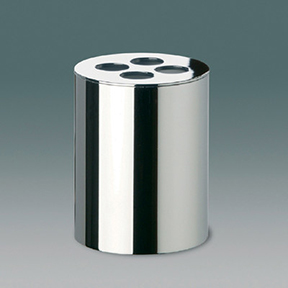
But I was aghast to discover the number of options for toothbrush holders — the thing you store your toothbrush in — that cost more than $300. You’d think for that price they’d be self-cleaning or silver-plated, or both. Not so. One such treasure is pictured in this first photo. The specifications only tell me it is about four inches tall, has a chrome finish and weighs one pound, so I don’t know what sets it apart, although a pound is pretty heavy for something this small.
It retails for $359.99. That’s a sale price, by the way.
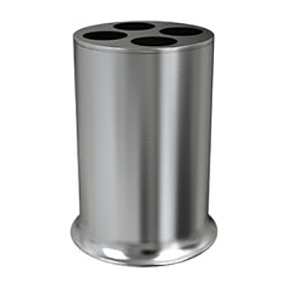
I took a quick look and discovered another holder, quite similar, on the same shopping site for a mere $22.99. It weighs about five ounces and is also about four inches tall. The finish wasn’t specified, nor was anything else.
Now you may have a preference for one over the other, but I know of few people who would find the first toothbrush holder — I emphasize, a toothbrush holder, and just think how grody those things can get — is worth 15 times more than the second one.
Is it possible to have more money than you reasonably know what to do with? Well, yes. You’ve likely heard the term “new money,” almost always spoken in a disparaging manner (that’s the only way I know how to pronounce it) and I imagine that’s one group who wouldn’t hesitate to pay twice the value of monthly food stamp benefits for one person on a toothbrush holder.
Years ago I worked for a man who would have charged up the Visa for virtually any amount if you told him it was how people in Europe spend their money on a toothbrush holder. (Just to be clear, it’s not.) Or if the label read “Ralph Lauren,” he’d pay whatever the asking price might have been. Of course he’d gone through bankruptcy three or four times before hitting 40.
Decorating a home costs money, no doubt about it. Some of us, particularly those on a tight budget, need to rely on creativity, clearance prices, patience and the cast-offs of generous friends with good taste when fixing up a room. We all might be guilty from time to time of spending more than an item is worth to our house, and there’s a point where that’s okay.
But if your toothbrush holder cost you more than my car payment…or even my car insurance payment…or just the cost of gas this month…I don’t know what to say.



![AdobeStock_96443843 [Converted] c geosap nbg](https://myworldwithwords.com/wp-content/uploads/2016/04/adobestock_96443843-converted-c-geosap-nbg.png?w=204&h=204) How many of us have been in a social situation in which we feel like a duck out of water, surrounded by graceful, sleek panthers? They slide from one individual to the next, mysterious, powerful and so, so pretty, while we waddle and quack.
How many of us have been in a social situation in which we feel like a duck out of water, surrounded by graceful, sleek panthers? They slide from one individual to the next, mysterious, powerful and so, so pretty, while we waddle and quack. When to make an entrance, how to make an entrance, and when & how to exit are prime social skills. If you’ve got those down, record that under “elegance.”


You must be logged in to post a comment.