Okay, never say never. But it seems unlikely these films could be made today, for the reasons I’ve listed.
I’ve added one film that was limited by the restrictions of yesteryear (and perhaps some bad choices by the producers, directors, screenwriters and/or actors). Still, the story is worth telling, and if the right people took it on…
All of these films have been reviewed on my other blog, Classic for a Reason. Click on the title to see the individual reviews, and if you get the chance, check out these movies!
Joel McCrea and Jean Arthur battle it out–and of course fall in love.
A single woman rents out the spare room in her apartment to two strange men? It was a controversial idea at the time, but today it likely would be nixed because of the danger factor, not the sexual one.
A man suspected of seducing an underage girl is sentenced to date her? While there would be outrage at the concept now, Cary Grant and Shirley Temple (with the able assistance of Myrna Loy) make it plausibleand–really funny.
Since we all know drunks don’t get more charming and capable with every martini, Nick and Nora’s sophisticated use of liquor would be suspect. Besides, some classics just should be left alone.
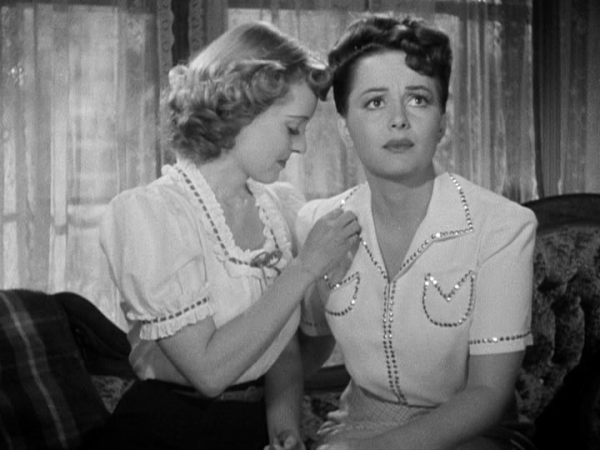
Bette Davis, Olivia de Havilland in a film worth re-making.
This is an incredible story based on the Pulitzer Prize-winning novel of the same name, and the movie is good, but it should be great. There is so much going on it actually would make a good multi-part series (you know, six episodes on HBO, that sort of thing). Bette Davis and Olivia de Havilland alone make it worth watching, and it was John Huston’s second film (after The Maltese Falcon), but it just doesn’t quite reach its full potential. And, I’d suggest they change the names of the lead characters. Stanley and Roy are simply not great names for women.
If I live to see 100, make that 101, let me live it like Olivia de Havilland, with class, humor…and in Paris.
Just last week, days before her birthday, she was given a damehood by Queen Elizabeth II for her services to drama. She is the oldest woman to receive this honor.
Dame Olivia was one of the top actresses of her time, with a career that spanned decades. She gained the respect of audiences and colleagues alike. But she represented more than just glamour and success. Through the influence gained by her talent, she fought for others, those without a voice, and changed lives as a result.
Publicity photo, circa 1945
A working woman in a sexist environment, she held her own against those who would pull her down and managed one of the most successful long-term careers in Hollywood history.
I’m far from the only one to take note of Dame Olivia’s qualities, now and then. In February 2016, The Oldie magazine, a satirical publication from London fighting ageism, named her “Oldie of the Year.”
Her response to that honor was delight and delightful. Over the years, her wit has shown in so many of her personal appearances, with a smile and a wink at life.
My fascination with and appreciation of Dame Olivia de Havilland began when I was high school, at the same school she had graduated from in 1934, Los Gatos High School in Los Gatos, Calif.
The summer between my junior and senior years I had a job working in the school library, and my tasks included repairing older books. One of those was the school’s 1934 yearbook, and the librarians turned a blind eye as I spent a little too much time looking for all mention of her. Even then, she stood out from her peers in her poise and class in front of a camera.
Classic movie fans, indeed anybody familiar with her work,
will know her best for two roles, as Melanie in Gone With the Wind and as the dashing Errol Flynn’s most frequent leading lady.
As Melanie in “Gone With the Wind”
She was nominated for an Academy Award as Best Supporting Actress for her work in Gone With the Wind in 1939, but it wasn’t until she starred in the phenomenal film To Each His Own in 1946 that she won her first Oscar, for Best Actress in a Leading Role. That was followed three years later by the same award for one of my favorite of her films, The Heiress.
In between those two wins, she received a Best Actress nomination for The Snake Pit, a ground-breaking film about the treatment of the mentally ill. Bringing those images to the screen created public awareness of the plight of millions, and those who suffer from mental illness today can be thankful for her work in what I hope & pray is now a long-outdated portrayal of institutionalization.
She had one sister, the late Joan Fontaine. Miss Fontaine was a year younger, and the two are the only sisters in Academy Award history to each win an Oscar for Best Actress.
For those who aren’t aware,
in Hollywood’s early years what was known as the studio system reigned, in which actors and actresses were under contract and controlled by the strict standards and seeming whims of the studio executives. Dame Olivia took her studio, Columbia Pictures, to court in 1943 and won, and the resulting decision changed labor laws, greatly reduced studio power and began the decline of the contract system.
As a result it was almost impossible for her to find work for a couple of years, but at the end of that time she began a comeback that reduced that gap in her work to a non-entity in her overall career.
Perhaps there were times in those years when she wondered if she should have been the one to take that stand. Even if she never wavered in her pride in her decision, she likely cried or otherwise railed over the blacklisting of her talent. I don’t know enough about her to know what her reaction may have been, except it would have been human.
She has stood her ground again, and filed a lawsuit against the FX network, suing for infringement of common law right of publicity, invasion of privacy and unjust enrichment. Her claim is based on the “inherently untrue” portrayal of her as a bitchy gossip-monger, something records readily available to producers would show to be false.
She was, rather, known to be gracious and kind, a woman who refrained from gossip and treated all with respect and dignity.
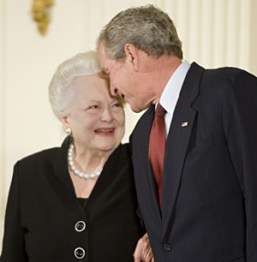
With President George W. Bush, receiving the National Medal of Arts
Although she is an American citizen, Dame Olivia has lived in Paris since 1960. She continued to act until the 1980s, and her last major public event was in 2008 when she was presented with the National Medal of Arts.
Our high school has an annual award, “The De Havilland Cup,” given to a student for a monologue performance. That tradition has lasted more than 70 years, and I expect it will continue for many more to come. It is a fine tribute to her talent and dedication to her craft, for it takes both those qualities to win this award.
Dame Olivia de Havilland was a force in Hollywood, and remains a strong & gracious woman. She is one of the last living stars from the Golden Age of Hollywood, that wonderful era from the 30s to 40s.*
Happy 101st birthday, Dame Olivia, and congratulations for a long and marvelous career, for your dignity and poise, for representing the best for working women everywhere.
*Those familiar with the “Golden Age of Hollywood” know that much of the work created during that time was a product of the studio system. It was a wonderful era for film, but not so much, perhaps, for many of the actors and actresses.
Here are some memorable–although not always admirable–moms in honor of Mother’s Day this Sunday.
Most of these women are flawed, but doing their best, which is all we can ask from anyone, right? And admittedly, perfect moms often (but not always) make boring characters on screen. Still, for the most part, these women have their redeeming qualities. And a few are down-right saints.
So if you can’t be with your mom this weekend, or even if you can, check one of these movies out.
Some of these films have been reviewed on my other blog, Classic for a Reason, and I’ve conveniently linked to those posts.
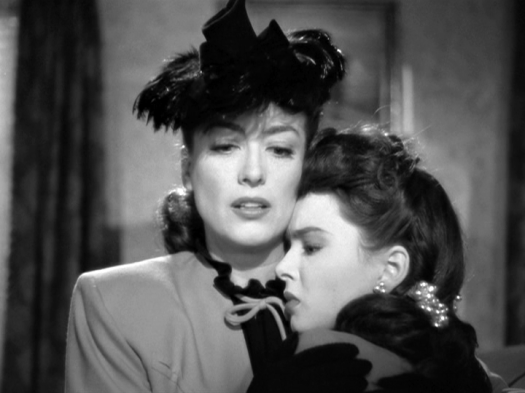
Mildred Pierce (Joan Crawford) does her daughter no favors, but which one gets what she deserves?
A single mom who will sacrifice anything for her ungrateful daughter, Mildred Pierce will have you screaming, “Are you kidding me?” at various points throughout the film. Each of the characters has his or her own flaws, and several of them aren’t ashamed to use them against the others. Joan Crawford won an Academy Award for her performance, and it’s one of her best roles, ever. The film was remade for HBO several years ago, and I hear good things about that version as well, although it is decidedly different.
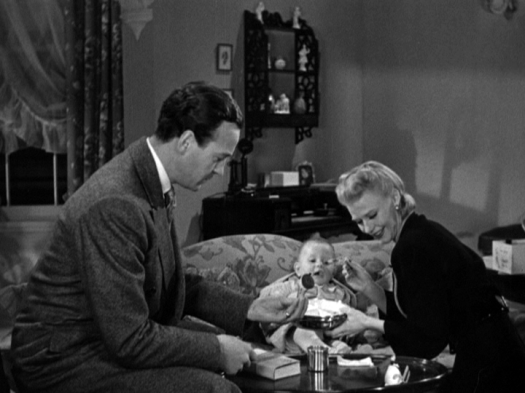
David Niven gives his best advice for feeding a baby–but Mama Ginger Rogers knows best.
Ginger Rogers’ seasonal job is about to end when she discovers an abandoned baby during her lunch hour. A series of misunderstandings lands that baby in her apartment, and to keep her job, she has to “admit” the baby is hers. David Niven plays opposite her in this charming comedy about getting what you want while going after what you think you need.
Barbara Stanwyck and Anne Shirley star as a devoted mother and daughter whose ways must part for their dreams to come true.
Stella is coarse and uncouth, and lucky enough to marry a society catch while he’s on the rebound. She’s not a particularly good wife, but her dedication to her only daughter is unparalleled. Barbara Stanwyck gives a wonderful performance in this tearjerker, one that raises more questions than it answers.
The World of Henry Orient
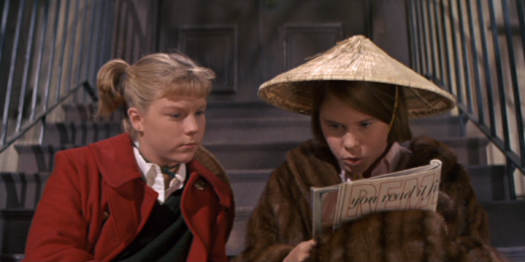
Tippy Walter, Merrie Spaeth–no, they’re not playing moms, but their mothers are memorable characters in this marvelous film.
Okay, this one isn’t about moms–nor is about Henry Orient, played by Peter Sellers. It’s about two young teen girls, played by Tippy Walker and Merrie Spaeth in their first film roles. The girls, Val and Marian, are, to use one of their own words, fantabolous in this heartwarming story. But adding to the charm are Phyllis Thaxter, as the compassionate, generous mom of Marian, Bibi Osterwald as her live-in best friend (by some accounts, Marian has two moms), and Angela Lansbury as Val’s self-absorbed, socially-conscious mother. Tom Bosley plays Lansbury’s long-suffering husband and father of Val. This is a wonderful film you will want to watch again and again.
Myrna Loy, Teresa Wright–the women who held the men, and each other, together
Myrna Loy took a step down to a supporting character role in this post-war classic, but her portrayal of the long-suffering wife of alcoholic husband Fredric March and mother of love-struck daughter Teresa Wright makes her one of the most beloved moms of classic films. This movie shines in every aspect, and Myrna Loy is one of the brightest spots.
Here are seven classic movies with messages that still resonate, with one or two seeming darn near prescient.
Of course dozens of other films from the same era these were produced are as relevant, funny, touching or otherwise worth watching today.
It should be noted all of these movies were made during the time the Production Code was firmly in place, making them conservative and downright tame by today’s standards. Still, the women are strong, something characteristic of many of the female roles of the 30s and 40s, yet ironically an element that began to be lost when the Code was phasing out.
And yes, this is blatant cross-promotion for my other blog, Classic for a Reason, with links to the full reviews you’ll find there. Thank you for visiting that blog, and for that matter, thank you for visiting this one!
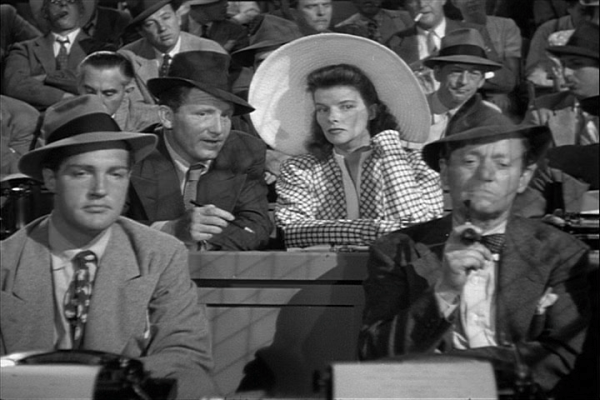
The film which brought Katharine Hepburn and Spencer Tracy together. Their chemistry is palpable, but that isn’t the only thing that makes this movie noteworthy today. Hepburn plays a highly capable, skilled woman who has a hard time adjusting to marriage, and Tracy is the long-suffering husband with the wisdom that could save their relationship. Wisdom that still means something in the 21st century.
This film was released in 1954, but it predicts today’s phenomenon of “being famous for being famous.” Judy Holliday plays the not-so-dumb blonde who wants more in life than what she sees as her inevitable lot, and makes the questionable decision to have her name splashed across giant billboards throughout New York City. Also starring Jack Lemmon in his first major screen role. A delightful tale, written by Garson Kanin.
The first film to depict alcoholism in a realistic manner, close to everything in this movie rings true today. There are a few stylistic elements that date the film, and perhaps a handful of aspects of the story line are distinctly from the era, but overall, this film is as timeless as, sadly, the plight of the alcoholic appears to be.
The tale of three serviceman adjusting to civilian life after serving in WWII, it is, in a larger sense, the story of anyone adjusting to a major change in his or her life. Subtle details fill out an already expansive story. While the starring roles all went to men, the supporting cast has several strong performances from top-notch actresses, including Myrna Loy. Winner of nine Academy Awards (with two of them going to Harold Russell, the only time an actor has won two Oscars for the same performance) and one of the best pictures of the 1940s.
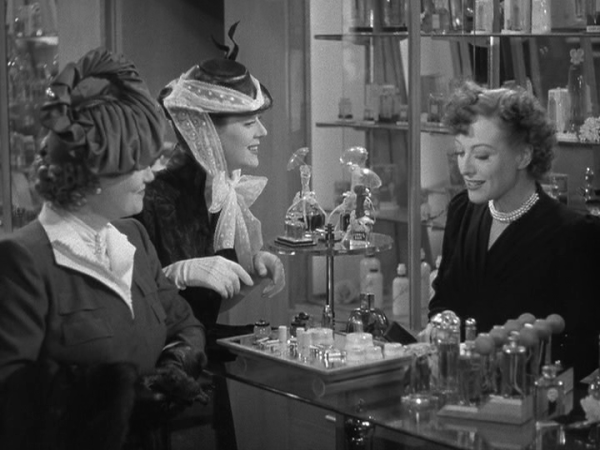
Not the weak 2008 remake, but the original from 1939, it looks at a tale as old as marriage and all the ways women can influence each other in their choices. Witty, sharp and sometimes biting, this is a classic like none other, with an all-female cast that includes many of the top actresses of the day. Based on the racy play by Clare Boothe Luce and made acceptable for Code standards by two clever screenwriters, Jane Murfin and Anita Loos.
This not-so-well-known film starring Bette Davis and Olivia de Havilland is not among director John Huston’s finest works. Still, it is worth the watch, if for no other reason than the performance of Ernest Anderson, who plays a young black man unjustly accused of a violent crime he had no part of, and the raw truth, then and now, of racism in our legal system. In fact, the movie was banned from release overseas because of its overt realism dealing with racial issues. Based on the Pulitzer-Prize winning novel by Ellen Glasgow.
And a seventh film I featured in an earlier similar post, but it’s worth repeating…we all know an Eve Harrington, and this is one of the greatest films of all time…
Sweet, baby-faced Eve isn’t who she first seems to be, and Margo Channing is faced with losing her status as the darling of the theatre-going public to this conniving up-and-comer. Bette Davis in one of her finest roles, with a great cast, including an Oscar-winning performance by George Sanders and a brief, yet memorable, appearance by Marilyn Monroe.
Here are eight films famous for either one line or one gesture–as well as being damn good movies.
Wondering if it’s a compliment to call someone “Eve Harrington?” Where did the David Bowie “You Remind Me of A Babe” routine originate? And what does that little brush of the finger against the nose mean?
Yes, this is blatant cross-promotion for my classic movie blog, Classic for a Reason. I’ve reviewed seven of the eight films there, and have conveniently linked to the individual reviews (click on the title).
Here, in no particular order, are the chosen eight:
Shirley Temple turns in a delightful performance as the love-struck teenager captivated by playboy Cary Grant. Of course it’s her older sister who catches his eye, but she’s the judge who almost sent him to jail. Instead, he’s sentenced to date the moony-eyed girl, under the watchful supervision of big sister Myrna Loy.
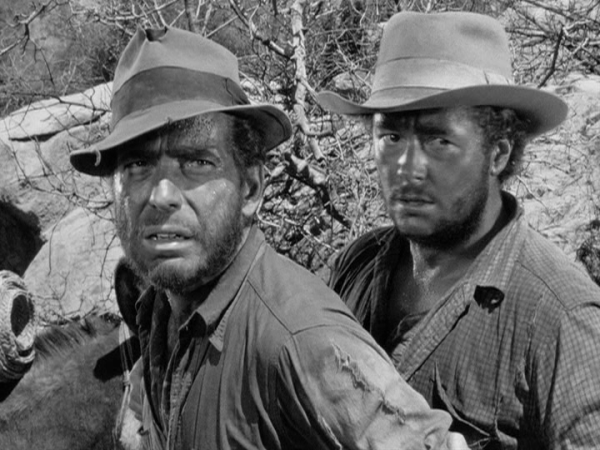
“Badges? We ain’t got no badges. We don’t need no badges. I don’t have to show you any stinkin’ badges!”
Humphrey Bogart and Tim Holt team together with Walter Huston (not shown) to mine for gold, and uncover a lot more than precious metal.
I stayed away from this film for a long time because I thought it was a western or some such that I wouldn’t enjoy. It’s nominally a western, but at its core it is a hard look at human nature and what happens when we’re faced with the worst in ourselves. Humphrey Bogart was never better–admittedly, he played more admirable characters in other films, but that’s the point. Considered by many to be director John Huston’s best film, and that’s saying a lot.
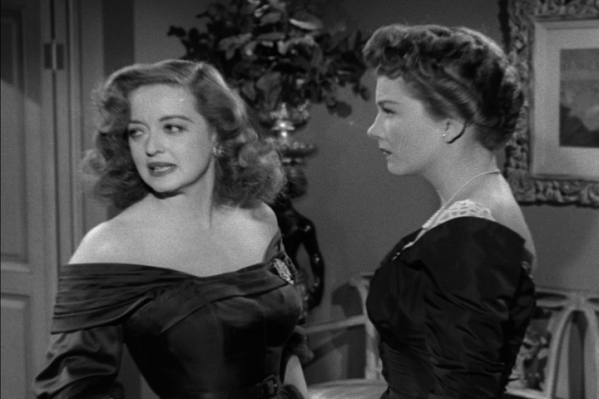
“Fasten your seatbelts–it’s going to be a bumpy night.”
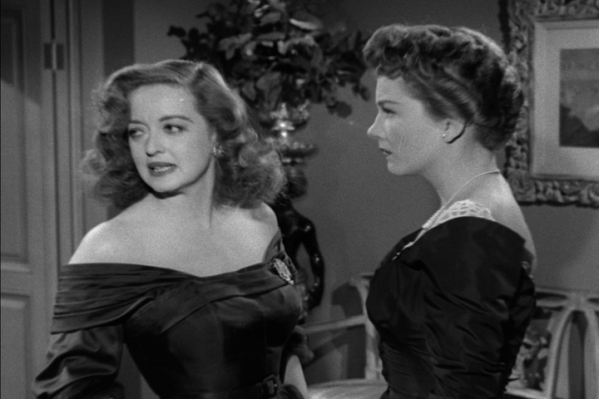
Bette Davis, Anne Baxter–offscreen these two became lifelong friends, onscreen, well that’s a different story.
If you haven’t seen this one, it’s time to check it out. If Fred and Ginger got me hooked, Margo Channing reeled me in to the world of classic movies. All About Eve is witty, sharp, human, with some deliciously evil characters to boot. All four women in this film were nominated for an Academy Award, the only time in Oscar history that honor has gone to four women from the same movie.
And yes, they had seatbelts in 1950 — mostly in airplanes.
You’ve heard the quote, heavy pseudo-Swedish accent and all. This is the film in which Garbo makes the statement that soon becomes identified with her personal life, fair or not.
Greta Garbo and John Barrymore, before censors required all kisses to be closed mouth.
This was the first ensemble film to come from Hollywood, and remains one of the best. As a pre-code film it’s a lot racier than you might expect, but the blatant sexuality is still primarily in the looks, innuendo and what’s not said between a man and a woman. In addition to Garbo, the film stars John Barrymore (before his career-ending decline due to alcoholism) and Lionel Barrymore, delightful as always.
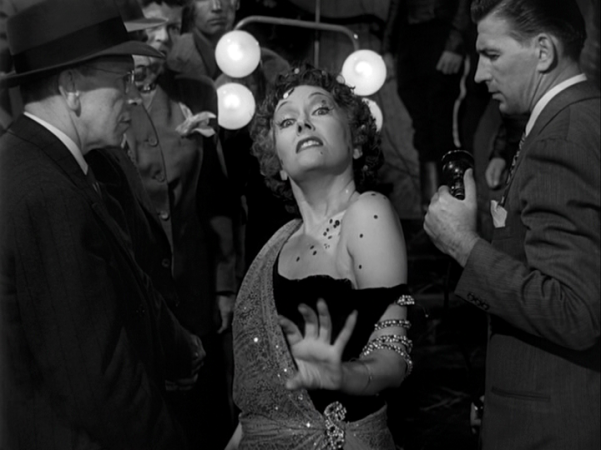
Gloria Swanson as Norma Desmond. The latter was known for proclaiming, “we said it with our eyes!” Yes, the eyes say it all.
Yeah, the old broad has lost it. Okay, old is relative…Gloria Swanson was 50 when this movie was made, but her film career was pretty much over. A star of silent films (and clips from one of them are shown in this movie), she wasn’t able to transition to the talkies. But she wasn’t the object of pity Norma Desmond became. This is a dark film and has achieved cult status, but is far more than this one scene. Complex, haunting and at moments really funny, Sunset Boulevard is a treat only writer/director Billy Wilder could deliver.
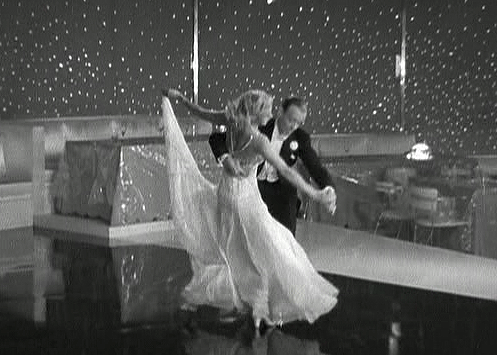
“I did everything Fred did, except backwards and in high heels.”
Ginger Rogers and Fred Astaire — Magic! And imagine managing that dress while you’re dancing. It wasn’t just the high heels that made her part challenging.
Backwards, not so much, but the high heels almost did Ginger Rogers in while filming the final dance number, “Never Gonna Dance.” Her feet were bleeding and had to be bandaged, but she insisted on continuing until they got it right–after 47 takes. What took so long? Nearly the entire number is a single shot, with one camera, and Fred Astaire was a perfectionist. Which means 80 years later, we still can get lost in the romance and grace of an Astaire/Rogers dance number. (And yes, I know the quote isn’t directly tied to the movie.)
The Sting–1973
Paul Newman
Robert Redford
You know the gesture — a quick brush of forefinger across the nose, a sign of complicity, a smug pat-on-the-back for pulling one off. If you’re under 40, you might not know its origin. Until now, that is. It was a move made famous in this phenomenal film with its phenomenal stars, Paul Newman and Robert Redford. There’s a plethora of talent in this movie, and of all the films to win the Academy Award for Best Picture, this one has to rank in the top ten. Years later Redford would tell of the time he finally watched it — on the VCR, with his grandson–and he noted, “hey, that’s a really good movie.” Yep.
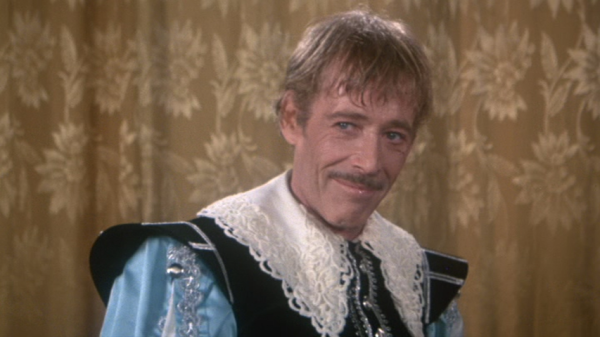
Peter O’Toole, who, unlike his character, was both an actor and a movie star.
Funny, touching, a little ribald and wonderfully nostalgic, this is the story of Alan Swann and his one-time appearance on the King Kaiser show in 1954. Based on comedian Mel Brooks’ experience as a young writer on the Sid Caesar show, in particular, the week Errol Flynn appeared, it tells the tale of Benjy Stone and his efforts to keep this movie star sober, at least until he’s appeared live on television and completed his contractual obligation. Look for Lainie Kazan as Benjy’s mother. O’Toole was nominated for an Academy Award for Best Actor, but lost to Ben Kingsley for his incredible portrayal of Gandhi.














 My World With Words
You must be logged in to post a comment.