The Saga Continues…
I have to give my Mimi credit — she doesn’t give up. Ever focused in her goal to explore this new territory, her retreat is momentary. With only seconds needed to regain her composure, she sets out once again to conquer all.
Pieces of the Whole
The Saga Continues…
I have to give my Mimi credit — she doesn’t give up. Ever focused in her goal to explore this new territory, her retreat is momentary. With only seconds needed to regain her composure, she sets out once again to conquer all.
The first time my cats met any dogs. The dog, you’ll see, had nominal interest.
“Always acknowledge a fault. This will throw those in authority off their guard and give you an opportunity to commit more.”
― Mark Twain
 Back when I was a reporter, there was a loyal yet somewhat annoying group of readers who picked apart every article and never hesitated to send us a daily critique of our mistakes, real or perceived. Somehow, I’d been lucky enough to miss out on most of their assessments. My fellow reporters, one in particular, made enough errors to keep them busy.
But one day it happened. I got the e-mail, or rather, my editor did. She called me in. “Sorry,” she said. “I don’t even know if he’s right or you’re right. Check your notes.”
I looked at the story. Damn. I’d made a mistake, pure and simple.
“Nope, it’s my mistake,” I told her. “I’ll return the e-mail.”
“Keep it short,” she advised. “Don’t say more than you have to.”
I kept it honest. “Dear Mr. Smith,” I wrote. “Thank you for your e-mail pointing out my error in today’s paper. You were right, it should read ‘this way‘ and not ‘that way.‘ While it’s not an excuse for my mistake, maybe a little explanation would help here. When I was writing the story, I thought the second sentence in paragraph three would work better if I switched it with the second sentence in paragraph two. The problem was, the transition sentence, the first sentence in paragraph three, was then incorrect. I apologize and we will run a correction in tomorrow’s paper.”
“Good luck,” the other reporters told me. “Mr. Smith is a jerk.”
 Well, so be it. I sent off the e-mail. Not three minutes later I received a call. It was Mr. Smith.
“I don’t care that you made the mistake,” he said. “We all make mistakes. But you’re the first reporter to admit it. I usually get a bunch of crazy excuses with the blame placed anywhere but on the reporter.”
I thanked Mr. Smith and smiled. It wasn’t the first mistake I’d made, and it likely wouldn’t be the last. But admitting it gave me the freedom to make more without someone calling me a fool, or losing their respect.
It also kept them off my back.
Image Credit: (Focus on the News) © GraphicStock

I have what some would call one of the most outdated degrees available today: news journalism, formerly called print journalism. We were groomed to work for newspapers.
I’m gue ssing current journalism majors get a good dousing of social media education as well, but the reality is, by the time today’s graduates with any sort of journalism degree are my age, their degree will also be outdated.
Which leads to this question: why do we go to college if everything we learn, all the knowledge we gain, becomes yesterday’s news in light of greater innovation, broader (or narrower) thinking, changes in what the workplace values?
Because education in and of itself has value.

I went to college twice. The first time I dropped out before graduating, something, quite frankly, I’ve never really regretted. I got what I wanted out of that experience, and if I had graduated, I never would have gone back and completed my education in a field for which I was far better suited.
It wasn’t easy, however, to go back, and when I dropped out, I had to explain my decision to several people in my life who knew that would be the case. Some understood, some did not. One friend was more upset than most, and when I told him I simply couldn’t pursue a degree in something I had no interest in vocationally, he asked me this: “what about education for the sake of education?”
The fact was, it wasn’t a well rounded learning experience at that college to start with, at least, not for me. Turns out that’s true at many colleges and universities. But he was right about the inherent value of education.
Today I no longer work in any field remotely related to my degree, yet having an education is an essential part of my success. You can tell the college graduates from the rest. Even those self-taught individuals, those who know lots of facts and can win any game of Trivial Pursuit, don’t have the polish that comes from the college experience. It is education; it is the process of learning, of deeper thinking, of using logic and research to reach your own conclusions that changes you.
Education for education’s sake.
Photo Credits: (typewriter) © GraphicStock; (Graduation Day) © carballo — Fotolia
One of the legacies that has carried from my great-grandparents to me was a respect for all people. All people.
My mom’s cousin, my great-aunt’s son, was as white as I am, a heritage that traces back, some of it, to New York in the 1790s, and from there we aren’t sure which European country our ancestors emigrated from in their search for a new life.
Anyway, he was raised without prejudice, meaning, it didn’t exist in his world.
 Then he married a Hawaiian woman. By this point, Hawaii was a state in our nation, and had been for more than a decade. She was as American as he was. But they weren’t allowed in some restaurants because she was Hawaiian. That was how they worded it, even. Now I don’t know anything more specific about her ethnic background; I’m guessing it may have been Filipino. I was a little young, so to me, she was Lena, she crocheted beautiful purple vests for me and my sister, and she served us 7-Up when we visited.
It was a shock to my mom’s cousin to see his wife treated in such a humiliating manner. He was an intelligent, educated man, not generally naive, but this was foreign to him. I’m proud to be related to someone for whom prejudice was that unknown, and I hope the heart of that nature can be found in me.
I know the people who follow my blog by and large are people who respect others, who empathize with anyone in pain, and who ache for the hurt of those who are persecuted, even in our country, by those who should know better. So I’m preaching to the choir and saying thank you at the same time.
I don’t know what it’s like to be black, Mexican or Muslim, or any of the other minorities treated so poorly by so many these days. I stumble and fumble in my efforts to understand the humiliation and anger, and every once in awhile something gets through.
A few years ago I was listening to a woman speak at a conference for those who worked with people with disabilities, as I did at the time. She has disabilities herself, is black, and was a prominent figure in Washington D.C. some time back. I apologize I don’t remember her name. At the end of her speech, I was surprised to hear her say when she’s asked how she wants to be identified, as an African-American, a woman, or a person with disabilities, it’s African-American first.
It put something into perspective for me. When you’re white, you don’t identify yourself by race. It isn’t an issue. When you’re black, it’s an issue every single day. Of course race is first. I’m embarrassed now it surprised me then.
 A friend of mine, who’s black, bought a very nice camera, and was struggling to get the settings right so he could take decent pictures of his family. Why? The default settings are for caucasian skin. It says that right in the manual.
I live in an apartment complex with a large Hispanic population, and many of my neighbors speak little English. For my part, I speak little Spanish, but I do know these two words: los gatos. The cats. One of my neighbor ladies was delighted at my response when I caught her once speaking, in Spanish, to my two cats as they sat in the windowsill. Embarrassed, she stopped, but I said, “It’s okay. Los gatos hablamos espanol.” I have no idea if that’s grammatically correct Spanish, but she understood me.
She’s probably my age, maybe a little older, and who knows when she moved to this country. Likely it was as an adult, and likely she’ll never know a lot of English. I had ancestors like that who came over from Poland, and they faced their share of prejudice. Even my dad experienced the mockery and disdainful attitudes a notable amount, and I grew up hearing Poles and Italians were invariably less intelligent. You’ve all heard that sort of thing before, and you get my point.
To my black friends, Hispanic friends, Indian, Middle Eastern, Asian, and any ethnic group I’m forgetting friends, I see your race, religion, ethnicity, and anything else that clearly identifies you as you. I don’t always know what it means. I don’t live it. But I respect it as part of you, and I will do what I can to teach others to do so as well. If only by example.
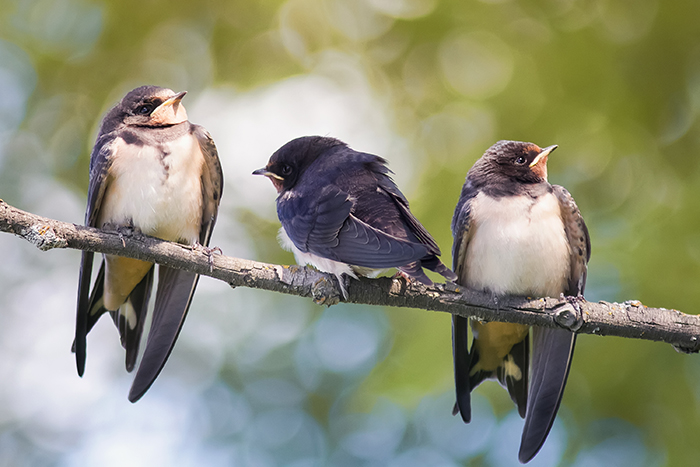
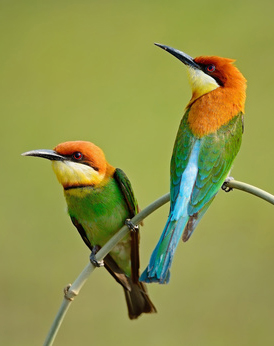
Photo Credits: bee-eaters © : panuruangjan — Fotolia; young swallows sitting on a branch © nataba — Fotolia; three titmouse birds in winter © Vera Kuttelvaserova — Fotolia
 My World With Words
You must be logged in to post a comment.