

hold your child’s hand, talk a little longer

Last week, our hearts were broken.

In response, my friend Wanda organized this silent vigil in our community for the victims of the Emanual AME Church shooting.

Silent Vigil at Crystal Bridges Museum
Silent Vigil for Victims of Mother Emanuel AME church shooting, June 24, 2015. Photo by Ali Wingood

Wanda has two daughters, ages 12 and 14. They’re learning what it means to be black in America. They’re black, so there’s that, and then there’s the bigger picture Wanda is helping them understand.

More to teach everyday, no doubt. It’s hard to be a parent.

In November of 1960,

Ruby Bridges made history. Many of you know the story. Six-year-old Ruby was one of the first black children to cross the lines at an all-white school in New Orleans to claim her right to an equal education in the public school system.

U.S. Marshalls with Ruby Bridges, November 14, 1960

U.S. Marshalls escorted her & her mother to the classroom that first day amidst rioting protesters, including one woman who put a black baby doll in a makeshift casket and shoved it at Ruby as she walked by.

Ruby was brave, no doubt about it. But when I saw this picture all I could think was how much courage her parents had, how deep their conviction and love must have been.

Her mama probably didn’t sleep much the night before. She likely ironed and starched that dress until it could stand up by itself. There may have been a petticoat, given the same care.

The little white anklets, perhaps with flowers embroidered on them. The patent leather shoes, polished until light bounced off them at every step. The bow pinned firmly in the hair.

When I picture Lucille Bridges, I see a woman who believed in what she and her baby girl were about to do. Ruby was going to shine, inside and out, as she changed history.

And she did change it. Today, countless doors have been opened for children everywhere, and each of us has benefited at one point or the other from the education they’ve earned.

All in my lifetime

Ruby’s story never would have happened if it hadn’t been for Abon & Lucille Bridges, her parents. I wouldn’t care so deeply if not for my parents, who raised three children in the turbulent ’60s and taught us about equality and justice as best they could.

We stumble through, work together and listen to each other.

That’s all anybody can expect, to teach the best way — and words — we know. Perhaps down the road we learn our lessons were somehow off the mark. Yet we stumble through, work together and listen to each other.

I’ve kept my heart, mind and eyes open for increasing understanding because of the foundation my parents laid. Whatever mistakes they may have made, at its heart, their message was right. They believed in equal opportunity. They saw people as individuals with value. They recognized the problems and knew the solutions were bigger, but would take time.

It’s hard to be a parent, but you make a difference. May it change your child’s world, and that of those around you, for the better.
Thanks to the Ruby Bridges Foundation, rubybridges.com, for facts on her story.

behave (as) yourself! whaaat?

During Christmas break when I was in seventh grade, I added bangs to my one length-fits-all hair style, and for most of my life since then I’ve kept them.

I’ll never be sure how much this plays into it, if at all, but I distinctly remember one boy complimenting me when we returned to class in January.

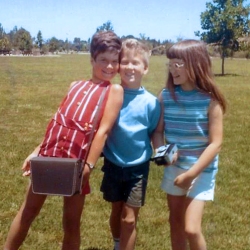
Beth, Thom & Me Summer 1972
My sister, brother and me (far right) the spring I was in seventh grade

“They look really nice,” he said. “They make your face look less round.”

He was a year older than me, and all through junior high, high school and until the last time I saw him, two years after I graduated, he was particularly nice to me.

I didn’t clue into it until about twenty years later, but I think it was more than just a kind nature.

This very popular, somewhat bad, really good-looking boy quite possibly liked me, the socially awkward girl whose weight fluctuated with the changing tide and insecurities overshadowed everything about her.

It makes you think. I’d realized it already on some level by this time (the age of 36 or 37), but it brought home a valuable truth: no one is who they appear to be on the outside. Why one kid is popular in high school is a bizarre combination of the “right” talents, good looks and circle of friends. He’s not better than the girl with none of that, and if he’s lucky, he knows it.

That continues throughout life. The seemingly perfect couple gets divorced. Most of us knew the Duggars would fall eventually (although perhaps not as far). There’s always the pastor who walks away from his church in shame…that’s just a given in any community. Okay, I’m being facetious with the last one. A bit.

The hooker with the heart of gold. A cliché to make a point.

A close friend of mine made the observation a few years ago that who we are is “not about behavior.” It rang true for me instantly.

In her case, her husband had had a benign brain tumor that affected the entirety of his behavior, including his ability to hold a job or even help with household chores.

Their church, in a gross misuse of its authority, directed him to leave his family until he could figure out how to become “the man of God his family needed him to be.”

He had a brain tumor. He had brain damage. His behavior had nothing to do with who he was.

Now, that’s an extreme example. But there are plenty of people, say, with mental illness, who do things that later shock and humiliate them. Virtually everyone I know, mentally ill or not, has done something so “unlike themselves” they have a hard time confessing it to others.

I wish I’d known that boy liked me, if in fact he did. I wish I’d had the confidence to openly reciprocate his feelings, because I probably would have felt something for him if I’d let myself. I could have learned, early on, one of life’s most valuable lessons: who we are is more than what others see, it’s more than how we behave, and it’s more than we’ll be able to discover in a lifetime.

bored? maybe. board? no!

You don’t want to play board games with me.

Not because I’m so good. I’m above average with most, but no superstar. You have a decent chance at beating me.

Board game player isolated.Wherein lies the problem. I don’t like getting beat in board games. Really don’t like it. I pout when I lose, so no one else likes it either. But they’re none too thrilled when I win. I can’t help myself. I gloat.



For some reason, success and failure at Parcheesi & Trivial Pursuit, Scrabble & Monopoly, mean way too much to me. This isn’t a side of myself I’m proud of, so I haven’t played a board game in years.

(Last time I did, by the way, I was partnered with my brother in a game of Trivial Pursuit. We won in one round – the first round. Yes, I’m smiling a little too smugly as I recall this.)

Another place you may not want to be seen with me? Hockey games. I get really low-class in my bloodlust at the rink. I want to see people get hurt going after that puck.

So I don’t go to hockey games anymore either, because in that case, I’m actually a little scared of myself.

Where on earth does this behavior come from? I can’t point to anything, especially the hockey. No offense intended to the sport, but any other time I have virtually no interest in it. I don’t know the rules, the strategies, nothing. Get me live at a game, though, and I’m not me.

parcheesi

Okay, the gloat/pout thing could be a bit of perfectionism, and it’s a competitive side of me that doesn’t have much of a chance to show itself elsewhere, since I am definitively non-athletic. Fit, yes, but I can’t throw, hit or catch a ball. I’m not fast. You get it.

Ah, it’s becoming clearer. I’ve been on the bottom when it comes to sports my entire life. With board games, I have a shot (so to speak). Take that, mean girls!

I know, I know, I hear it. My conclusion here should be, “well, best thing is to give up this desire to beat everyone else. Just enjoy the games and the company with it.”

Rather, I find myself thinking, I need to discover something I can almost always win at.

Almost? Always.

I have a little work to do.


Photo Credits: (top) © isuaneye; (bottom) © carballo, (both) DollarPhotoClub.com

but I want you to like me

Am I an Ugly American? I certainly recognize it in others.

travel to Europe lrBack before the Euro was in circulation, it could be a challenge for American tourists & business travelers to rid themselves of one nation’s coins before entering another country. You couldn’t trade in coins internationally, and tended to spend them at the border.


My boss and I were traveling from France into Germany, and we stopped at a bar he was convinced few Americans knew about.

“Bonjour,” I said to the bartender, who winked at me as he gestured to us to sit at the bar.

As we paid for our drinks, I started to pull out any French coins I had. We were about to end up with a fair amount of money that would be useless to us.

“Don’t do that,” my boss said in a loud whisper. “They’ll know we’re Americans.”

“So what? We’re Americans,” I replied. “I can’t change that.” He looked furious.

“Trust me,” I went on, matching his stage whisper. “They know we’re Americans. They spotted us the minute we walked in. Right?” I looked to the bartender, who gestured to the crowd behind us. I turned and most were smiling and nodding their heads.

I asked the bartender if it were a problem paying in coins. “We have currency,” I told him, “and we really don’t want to inconvenience you.”

“It’s not a problem,” he said, “Money is money. And tourists, we understand.”

“’L’argent est l’argent’?” I replied. I’d studied French. “Or is it, ‘l’argent c’est l’argent’?”

I wasn’t sure if my grammar was right, but the words were correct.

“Parlez-vous français?” he asked with a grin.

I rattled off a phrase I’d memorized in French saying, basically, I’d studied French for six years but now I’ve forgotten most of it. “Actually,” I continued in English, “I’m having a hard time understanding what people are saying here.”

© canicula - Dollar Photo ClubWe went on to have a conversation I’m sure he’d had a dozen – or a hundred – times before, how it’s one thing to learn a language in a classroom, and another to speak it in a native environment. How Americans who study French have little opportunity to actually practice it anywhere outside the classroom. And so on.

I felt so burdened NOT to be the Ugly American, I was afraid I was becoming one.

My boss was fuming. “They hate Americans,” he told me, again with his not-so-subtle whisper.

“Well, I can’t do anything about that,” I said, not even pretending to whisper, and turned to the bartender. “I hope I’ve been respectful. It’s hard sometimes, not knowing how you’re perceived.”

Immediately I was pretty sure I knew how he perceived my boss. We both seemingly deliberately weren’t looking at him.

“If I didn’t like tourists, all tourists, I’d open a bar somewhere else,” the bartender said, and winked again.

We got up to leave. “Au revoir,” I said.

“A bientôt,” the bartender replied, and moved toward another customer, American, I guessed. A few others seated at tables nodded at us as we walked out, and I smiled at them and nodded back.

“I don’t know what he’s talking about,” my boss said. “Americans don’t know about this place.”

Sacré bleu! Oh wait, the French don’t actually say that.

Image Credits: (top) Map © Teiteosia – Dreamstime.com Airplane graphic © Paul Herbert – Fotolia.com; (bottom) Eiffel Tower graphic © canicula – DollarPhotoClub.com

if only I could curse and fly and eat pumpkin pie

Disney had a few things right, For example, Dumbo. His experience rings true. I’m quite certain if you get drunk and learn to fly, you will in fact become popular, and probably won’t be bullied anymore.

How did they get away with that? A different time, I guess.

movie ticket angled smWait, that movie was released in 1941, the height of strict standards in film known as the Motion Picture Production Code. You’d think sending that message to children would be borderline, at best, and the Code didn’t tolerate a lot of borderline at that point.

I guess drunk cartoon characters weren’t taboo. Or perhaps because Dumbo didn’t intend to drink champagne, the message is different.

Warner Bros. cartoon characters used to sing, “no more cursing, rehearsing our parts” at the beginning of each show. Now it’s “no more nursing, rehearsing our parts.” Nursing, of course, as in nursing something along — a pretty outdated expression, but nothing else rhymes.

They were cursing from 1944 to 1964. Well, not on camera, and saying you would curse met code standards for adults, so I guess no one seriously questioned it for kids. And frankly, that change irritates me. Unless Bugs Bunny actually cursed, big deal. Of all the battles to pick, petitioning for new wording there seems useless, and the difference sounds weird to boot.

(Bugs was a bit of a wise-ass, and Elmer Fudd was a grouch, so it’s easy to imagine them swearing, but that would leave me disillusioned.)

raw vegetables in wicker basket isolated on white

Standards are a funny thing. I have a friend who’s a vegetarian, and endlessly wears us out preaching about the horrors related to eating meat, particularly what it does to your body over a lifetime. Still, she has no problem ordering dessert, as long as it’s “vegetable based” (her words). Like carrot cake. Seriously.

No doubt we’re all guilty of something similar, something we probably don’t recognize anymore than my friend sees that her choice to eat carrot cake but not beef isn’t logical to most. I tried hard to think of my own such inconsistency, but couldn’t come up with anything. Well, given my logic that we’re blind to our own conflicting behavior, that makes sense

Ooooh. Was calling Bugs a wise-ass inconsistent with the sentences immediately preceding that comment?

Okay, let my friend eat cake, and I’ll eat my words.


Image credits: (top) © Elena Baryshkina – DollarPhotoClub.com; (bottom) © monticellllo – DollarPhotoClub.com